

Presenter(s)
Ashley Marie Harrison
Files
Download Project (725 KB)
Description
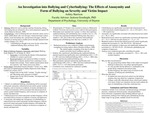
Bullying has been a problem for many years, but due to the development of electronic communication, cyberbullying in particular has recently become a widespread problem (Boulton, Hardcastle, Down, Fowles, & Simmonds, 2014). Research suggests that cyberbullying may have a greater negative impact for victims than traditional bullying (Gilroy, 2013; Walker, Sockman, & Koehen, 2011). Previous research suggests that cyberbullying may cause impaired mental health and psychological distress and may increase risk factors for suicide among college students (Zalaquett & Chatters, 2014). Research also suggests that when the victims do not know the identity of a perpetrator, it decreases the perceived control the victim has over the bullying situation (Sticca & Parren, 2013). It was hypothesized that cyberbullying victimization would be associated with greater depression and anxiety than traditional bullying victimization alone, and that higher levels of perpetrator anonymity, reduced control, and increased frequency of victimization would explain, or mediate, this difference. Mediation analyses indicated that a reduction in perceived control significantly mediated the association (b = .09, 95% CI = .006 to .246) between cyberbullying and depression. Mediation analyses also revealed frequency of bullying to significantly mediate the association (b = -.08, 95% CI = -.204 to -.005) between cyberbullying and anxiety. These findings indicate that students who experience cyberbullying in addition to traditional bullying, compared to those only experiencing traditional bullying, experienced higher levels of anxiety and depression owing to a reduction in perceived control and an increase in frequency of victimization. These findings suggest that negative consequences of bullying in college may be mitigated by promoting awareness among students to increase their perceived control. Findings also suggest that risk for depression and anxiety in college may be mitigated by promoting bullying prevention programs to reduce frequency of cyberbullying victimization.
Publication Date
4-18-2018
Project Designation
Graduate Research
Primary Advisor
Jackson A. Goodnight
Primary Advisor's Department
Psychology
Keywords
Stander Symposium project
Recommended Citation
"An Investigation into Bullying and Cyberbullying: The Effects of Anonymity and Form of Bullying on Severity of Victim Impact" (2018). Stander Symposium Projects. 1274.
https://ecommons.udayton.edu/stander_posters/1274