

Presenter(s)
Ryan E Restrepo
Files
Download Project (753 KB)
Description
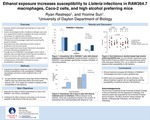
Excessive alcohol consumption has long been an issue in the United States. Listeria monocytogenes (LM), a foodborne pathogen, was used as an experimental model to investigate the impact of alcohol consumption on opportunistic infections. During LM infections, LM can pass through the intestinal epithelial barrier and infiltrate immune macrophages tasked with preventing the spread of infection. Once inside the macrophages, LM produces the toxin Listeriolysin O (LLO) in order to proliferate in the host cell cytosol. Previous experiments have shown that alcohol consumption increases intestinal permeability for LM. Furthermore, in the presence of alcohol LM was shown to have a reduced LLO production. Through the use of RAW 264.7 macrophage cell cultures, the effect of alcohol on immune cell function was studied. These experiments were conducted in order to establish a more complete picture of the effect of alcohol on human susceptibility to LM infection.
Publication Date
4-24-2019
Project Designation
Honors Thesis
Primary Advisor
Yvonne Y. Sun
Primary Advisor's Department
Biology
Keywords
Stander Symposium project
Recommended Citation
"Establishing the Effect of Ethanol on Listeria Infection" (2019). Stander Symposium Projects. 1600.
https://ecommons.udayton.edu/stander_posters/1600