

Presenter(s)
Avery H. Ozimek, Rusty P. Schnellinger, Laura E. Stayton, Anne L. Steel
Files
Download Project (272 KB)
Description
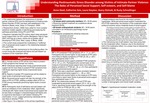
The relationship between the experience of intimate partner violence (IPV) and the development of Posttraumatic Stress Disorder (PTSD) has been well established in the literature (Basile, Arias, Desai, & Thompson, 2004). However, researchers have called for more complex statistical models capable of identifying and analyzing the pathways potentially linking IPV and PTSD. Research indicates that IPV victims report lower levels of perceived social support than non-IPV victims (Bengtsson-Tops & Tops, 2007) and that as a result, victims are at greater risk of developing PTSD (Ozer, Best, Lipsey, & Weiss, 2008). The current study analyzed the moderating or âbufferingâ role of perceived social support in the relationship between IPV and PTSD. It was hypothesized that the relationship between IPV and PTSD would be stronger among individuals perceiving lower social support. In addition, it was hypothesized that the relationship between PTSD and the interaction of IPV and perceived social support would be accounted for by the mediating roles of characterological self-blame and self-esteem. The hypotheses were tested by distributing questionnaires to 132 adult female participants recruited at a substance abuse treatment facility and a private university. The results indicated that both IPV and perceived social support predicted PTSD, and perceived social support moderated the relationship between IPV and PTSD. At the extreme levels of perceived social support, the relationship between IPV and PTSD was weaker among individuals perceiving high levels of social support than among those perceiving low levels of social support. However, at the moderate levels of perceived social support, the relationship between IPV and PTSD was stronger among individuals perceiving high levels of social support than among those perceiving low levels of social support. Lastly, the results showed that self-esteem mediated the relationship between PTSD and the IPV x Perceived Social Support interaction variable.
Publication Date
4-18-2012
Project Designation
Graduate Research
Primary Advisor
Catherine L. Zois
Primary Advisor's Department
Psychology
Keywords
Stander Symposium project
Recommended Citation
"Understanding Posttraumatic Stress Disorder among Victims of Intimate Partner Violence: The Roles of Perceived Social Support, Self-esteem, and Self-blame" (2012). Stander Symposium Projects. 164.
https://ecommons.udayton.edu/stander_posters/164