

Presenter(s)
Amy C. Feltz
Files
Download Project (1.1 MB)
Description
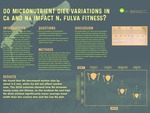
Nylanderia fulva, known as the Tawny Crazy Ant, is a highly destructive invasive ant that arrived from South America to the Southeast U.S. in 2002. In their invasive range, this ant can reach a density 100 times greater than native ants and their nests contain multiple queens and workers that show no signs of intraspecific aggression, allowing the colonies to stretch thousands of kilometers along the Texas coastline. Nylanderia fulva are important to study in coastal tallgrass prairies because these ants threaten biodiversity in this imperiled ecosystem, and their abundance is driven by marine-derived nutrients, such as calcium and sodium, that are deposited by precipitation along the coast. The main question in this experiment is: how do changes in micronutrient availability in coastal tallgrass prairies affect Nylanderia fulva fitness? More specifically, we were seeking to determine: does the total amount and ratio of Ca to Na in the diet of N. fulva affect worker size? We hypothesized that the amount of Ca in N. fulva food will increase ant size while increasing Na in the food will decrease ant size. To determine how the ratio of Ca:Na affects worker size, we collected 80 colonies of N. fulva and conducted 50-day feeding trials with 16 different diets that varied the amount of Ca and Na in their food (by increasing 10%, 25%, and 50%) in 2018. At the end of the experiment, we measured the head width of 10 ants from each colony to determine worker size in each diet variation. Ca increased colony biomass while Na decreased worker size. Our findings suggest that N. fulva seeks Ca to increase colony growth, which may be an important mechanism driving colony success. Additionally, because Na decreased N. fulva worker size, increases in Na could lead to a reduction in competition among native ant species and decrease their ability to forage for food.
Publication Date
4-22-2021
Project Designation
Course Project
Primary Advisor
Madison M. Hilling, Kathleen A. Kargl, Chelse M. Prather, Ryan William Reihart
Primary Advisor's Department
Biology
Keywords
Stander Symposium project, College of Arts and Sciences
United Nations Sustainable Development Goals
Climate Action
Recommended Citation
"Check Your Ego at the Shore: Marine-Derived Nutrients Drive Size Variation in the Invasive Tawny Crazy Ant" (2021). Stander Symposium Projects. 2111.
https://ecommons.udayton.edu/stander_posters/2111

Comments
This poster reflects research conducted as part of a course project designed to give students experience in the research process. Course: BIO 499