

Presenter(s)
Adam Barnas, Ellen J. Hart, Natalya N. Lynn, Lauren M. Pytel
Files
Download Project (637 KB)
Description
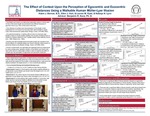
The Muller-Lyer illusion is a geometric illusion in which lines of the same length are perceived to be different because of forms (e.g. 'fins') at the ends. This influence of context upon the perception of length is well-established for 2-D illusions but has also been demonstrated in larger-scale, three-dimensional spatial tasks (Wraga, Creem and Proffitt, 2000). Across three experiments, we utilized a walkable variation of the Muller-Lyer illusion to further examine the effect of context upon the perception of egocentric and exocentric distances. Whereas the traditional Muller-Lyer illusion utilizes shapes to manipulate the context of the line, we employed human forms to manipulate context (i.e., facing direction of human targets). We predicted that the facing direction of the human target would influence magnitude estimates of target distance, similar to the way the placement of geometric forms at the ends of lines influence judgments of line length. However, we also predicted that action-based indicators of perceived distance (e.g. walking to the previously-viewed target person without vision) would not be influenced by the contextual information provided by the human target's facing direction. In Experiments 1 and 2, which are replications and extensions of previous research, participants viewed one human target that was facing toward or away and then, without vision, walked a distance that matched the perceived distance to the target person. Results from these experiments suggest that action-based indicators of perceived distance are immune to contextual influences of human target facing direction. In Experiment 3, participants will view two human targets that are either facing toward or away from each other, and will verbally estimate the distance between the two human targets in conjunction to walking the perceived distance between the target persons. The results from these experiments will speak to the role of contextual information in spatial perception.
Publication Date
4-17-2013
Project Designation
Independent Research
Primary Advisor
Benjamin R. Kunz
Primary Advisor's Department
Psychology
Keywords
Stander Symposium project
Recommended Citation
"The Effect of Context Upon the Perception of Egocentric and Exocentric Distances Using a Walkable Human Muller-Lyer Illusion" (2013). Stander Symposium Projects. 212.
https://ecommons.udayton.edu/stander_posters/212