

Presenter(s)
Ryan J. Maguire, Lauren Ashley Stoops
Files
Download Project (868 KB)
Description
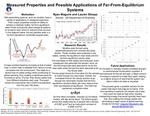
Self-assembling systems, such as micelles, have a variety of applications in biological organisms. Their unique properties include an ability to achieve a relatively stable, far-from-equilibrium state that in turn yields a number of unique aspects upon an individual system. Distinct properties of a far-from-equilibrium system include unusually low shear-viscosity, a lower degree of packing in the polar head groups, a higher degree of packing in the hydrophilic hydrocarbon chains, and an overall increase in chaos. These properties allow biological systems to conserve heat, especially due to the unique intermolecular interactions demonstrated through the shear-viscosity. These studies provide possible macroscopic uses for micelles and other far-from-equilibrium systems to ultimately reduce the waste heat emitted by humanity and instead utilize this heat as energy, ultimately limiting the impact of human actions on climate change and conserving Earth's ecological systems.
Publication Date
4-22-2021
Project Designation
Course Project
Primary Advisor
Yoon S. Lee
Primary Advisor's Department
Chemistry
Keywords
Stander Symposium project, College of Arts and Sciences
United Nations Sustainable Development Goals
Climate Action
Recommended Citation
"Measured Properties and Possible Applications of Far-From-Equilibrium Systems" (2021). Stander Symposium Projects. 2136.
https://ecommons.udayton.edu/stander_posters/2136

Comments
This poster reflects research conducted as part of a course project designed to give students experience in the research process. Course: CHM 304L