

Presenter(s)
Thomas Mays
Files
Download Project (742 KB)
Description
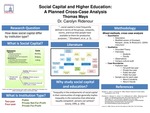
A college student's academic experiences and post-graduate outcomes can be shaped by their social relationships with faculty, administration, staff, and fellow students. Also known as social capital, this network of relationships and resources can benefit students during and after their college careers. Social capital research involving higher education has primarily focused on measures of groups and networks, often including the roles of family, community, and institutions in social capital development. While the literature includes insight into social capital and higher education, research lacks in the area of how social capital development compares between institution types as defined by level of education (two-year and four-year) and organizational control (public, private, or for-profit). This distinction is important because of the differences in social backgrounds of students that gravitate towards specific institution types. Social capital should be identified as an additional layer of the college curriculum, adding another dimension beyond the accumulation of knowledge and experience. To research social capital development in higher education, I am designing a study that examines social capital using a mixed-methods cross-case comparison design. An instrument developed by Grootaert, Narayan, Jones, and Woolcock (2004) and used by the World Bank will be used for quantitative data collection, while interviews, observations, and document analysis will be implemented for qualitative data collection. My poster will detail the literature review, social capital model, and research methodology that are a part of my ongoing dissertation research.
Publication Date
4-17-2013
Project Designation
Graduate Research
Primary Advisor
Carolyn S. Ridenour
Primary Advisor's Department
Educational Leadership
Keywords
Stander Symposium project
Recommended Citation
"Social Capital Development in Higher Education: A Cross-Case Analysis" (2013). Stander Symposium Projects. 305.
https://ecommons.udayton.edu/stander_posters/305