

Presenter(s)
Merrick Hirt
Files
Download Project (2.1 MB)
Description
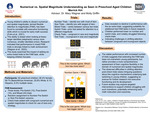
The ability of young children to differentiate between numerical and spatial magnitudes is correlated with executive functioning skills and has been recognized as a pivotal predictor of early math success (Fuhs et al., 2021). This ability is defined as flexible attention to magnitudes (FAM). In the current study, we expanded on previous findings which concluded that a child's performance in mixed FAM trials, where the child is asked to switch back and forth between numerical and spatial magnitudes, is most strongly connected to math achievement (Wagner et. al., 2023). To examine this, we added six additional mixed trials to the existing FAM task to see if the additional trials would have an effect on data collection. Data was collected from 63 preschool children (aged 3-5) where in varying levels, children were asked to point to boxes based on instructions to identify the box with either the larger objects, or the most objects. In a third level the previous two levels were mixed and the child was asked to make their selection based on the color of the box. We found that children’s performance did not decline in the 6 additional trials, suggesting 18 test trials will be suitable for future use of the FAM task. As expected, children scored lower on number trials and switch trials. Notably, children also scored worse on trials directly following check trials, suggesting that children struggle to switch between questions about incongruent and congruent objects. This distinction has been noted and is a possible direction for future research.
Publication Date
4-17-2024
Project Designation
Independent Research
Primary Advisor
Mary Catherine Wagner
Primary Advisor's Department
Psychology
Keywords
Stander Symposium, College of Arts and Sciences
Institutional Learning Goals
Scholarship; Community; Diversity
Recommended Citation
"Numerical vs. Spatial Magnitude Understanding as Seen in Preschool Aged Children" (2024). Stander Symposium Projects. 3323.
https://ecommons.udayton.edu/stander_posters/3323

Comments
Presentation: 10:45-12:00, Kennedy Union Ballroom