

Presenter(s)
Lydia Andrews
Files
Download Project (329 KB)
Description
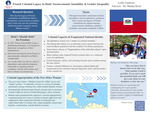
This research examines how Haiti’s colonial past, particularly its exploitative plantation economy (1697–1804) and the burden of post-independence debt (1825–1947), has contributed to systemic financial hardship and gender inequality. The poto-mitan figure, derived from the Haitian Creole words for “pillar” (poto) and “center” (mitan), is often viewed as a source of strength that symbolizes resilience, self-sacrifice, and responsibility, particularly among working-class, dark-skinned Haitian women. However, this figure, emerging from colonial and postcolonial labor structures, places disproportionate economic burdens on women while devaluing their contributions. This social construct has reinforced a gendered and racialized division of labor, limiting Haitian women’s economic mobility. Over the past fifty years (1970s–present), continued economic instability, worsened by political unrest and foreign interventions, has exacerbated these gender disparities, constricting Haitian women’s participation in the formal economy. Through an analysis of historical colonial policies, post-independence economic struggles, and contemporary gendered labor dynamics, this research seeks to examine how colonial legacies continue to shape economic and social inequalities in Haiti.
Publication Date
4-23-2025
Project Designation
Capstone Project
Primary Advisor
Masha I. Kisel
Primary Advisor's Department
Global Languages and Cultures
Keywords
Stander Symposium, College of Arts and Sciences
Institutional Learning Goals
Critical Evaluation of Our Times; Diversity
Recommended Citation
"The Legacy of French Colonialism in Haiti: Economic Instability and Gender Inequality" (2025). Stander Symposium Projects. 3802.
https://ecommons.udayton.edu/stander_posters/3802

Comments
9:00-10:15, Kennedy Union Ballroom