

Presenter(s)
Reed Diller, Andrew Mosler
Files
Download Project (386 KB)
Description
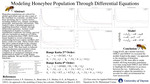
Honeybee populations are critical for global agriculture and are also a part of the food that we consume, yet they have been declining due to various factors including habitat loss, climate variability, pesticides, and parasitic infestations. This study (Romero-Leiton, Gutierrez, Benavides, Molina, Pulgarín, 2022) takes a detailed approach to modeling honeybee colonies through differential equations. Authors used mathematical models to explore equilibrium conditions for colony survival, and also included an analysis of USDA honey production data (1985–2019) with linear models to reveal a declining relationship between colony numbers and honey yield over time. These results show that stress induced death in the colonies significantly impacts the stability of the colony itself. This then leads to reduced honey production and potential colony collapse. In this work we present a comparison of numerical solutions of the mathematical model in (Romero-Leiton, Gutierrez, Benavides, Molina, Pulgarín, 2022) using Runge-Kutta methods. We use MATLAB’s built-in functions.
Publication Date
4-23-2025
Project Designation
Course Project - MTH 219 04
Primary Advisor
Muhammad Usman
Primary Advisor's Department
Mathematics
Keywords
Stander Symposium, College of Arts and Sciences
Recommended Citation
"Modeling Honeybee Population Through Differential Equations" (2025). Stander Symposium Projects. 3809.
https://ecommons.udayton.edu/stander_posters/3809

Comments
10:45-12:00, Kennedy Union Ballroom