

Presenter(s)
Sean Kapp, Gavin Mchale
Files
Download Project (762 KB)
Description
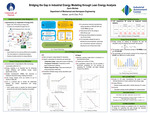
HVAC systems account for a significant portion of the energy consumption within the industrial sector. Specifically within chemical manufacturing facilities, fume hoods contribute heavily to HVAC energy use by continuously exhausting conditioned air. While advanced energy modeling techniques exist, small and medium-sized manufacturers (SMMs) often lack the resources and data required to implement complex machine learning-based solutions. An inability to collect useful information on energy patterns throughout the year can be a large obstacle for these facilities in deciding which changes will have the largest benefit for the company. Depending on the complexity of the energy model, predictions can be made based on a variety of factors. Changes in outdoor temperature plays a primary role in the variation of monthly energy usage. This study presents Lean Energy Analysis (LEA) as a practical and effective approach for assessing weather-dependent energy consumption in manufacturing facilities. LEA utilizes energy billing data to model energy-weather dependence through a piecewise linear changepoint analysis, enabling manufacturers to identify inefficiencies and predict energy savings from efficiency measures. A comparative analysis between LEA and the Random Forest (RF) machine learning model was conducted to validate the accuracy and utility of LEA for energy modeling. The results demonstrate that while RF models can provide strong predictive accuracy, they lack transparency and requires many features to be robust. In contrast, LEA effectively identifies independent energy usage, changepoint temperatures, and weather-dependent slopes as distinct, physically meaningful quantities, offering actionable insights for energy optimization without the need for extensive sensor networks. A case study is conducted at a chemical manufacturing facility where excessive fume hood usage was identified as a major contributor to HVAC energy waste. By applying LEA, the research team quantified the energy savings potential of lowering fume hood doors when not in use. Implementing this measure resulted in an annual reduction of 191,259 kWh in electricity and 729 MMBtu in natural gas, leading to cost savings of $18,851 and a carbon footprint reduction of 129 metric tons. This study highlights the advantages of LEA for SMMs seeking to optimize energy efficiency without the cost and complexity of high-tech energy modeling solutions. By leveraging historical data, LEA provides a low-cost, data-driven framework for energy assessment and sustainability improvements in industrial facilities.
Publication Date
4-23-2025
Project Designation
Independent Research
Primary Advisor
Jun-Ki Choi
Primary Advisor's Department
Mechanical and Aerospace Engineering
Keywords
Stander Symposium, School of Engineering
Institutional Learning Goals
Scholarship; Scholarship; Scholarship
Recommended Citation
"Bridging the Gap in Industrial Energy Modeling through Lean Energy Analysis" (2025). Stander Symposium Projects. 3858.
https://ecommons.udayton.edu/stander_posters/3858

Comments
3:00-4:15, Kennedy Union Ballroom