

Presenter(s)
Anthony Lococo
Files
Download Project (810 KB)
Description
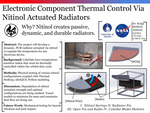
This project aims to develop and optimize a dynamic radiator fin to cool any electronic device in a space environment. Historically, these devices have been subject to temperature limits, as they cannot become too hot or too cold within their orbital duty cycle. This duty cycle corresponds to a spacecraft's orbit, as the device needs to idle or perform functions along certain arcs during its orbit. Traditionally, managing this has been done through creating a conduction pathway to space directly from the electronics, or through constructing static radiators which protrude into space. Both of these issues are problematic, as they cannot adapt to the variable heat loads which the electronics induce. The solution is a dynamic radiator, which is able to retreat inside the spacecraft and protrude outward according to the demands of the system. When inside, it will collect the heat of the system, and when outside, it will release it into space. The device will be passively actuated via nitinol, which has shape-memory alloy (SMA) characteristics. As the nitinol undergoes its phase change, it either heats up and stiffens to a trained shape or cools down and subsequently relaxes. This will be implemented by instituting nitinol wires to bend outward, springs to extend, or torque tubes to twist, forcing the radiator fin to extend outwards into space. The design consists of material characterization, experimental testing, and theoretical modeling of the system. Experimental testing includes identifying an optimal actuation nitinol attachment method. The Thermal Desktop model will be used to tune contact resistances. The Python model will vary properties significant to heat transfer to optimize the design. Current results show that proper thermal management can be achieved via modeling, and experimental testing has shown a maximum actuation angle of 60 degrees, which provides significant heat transfer into space.
Publication Date
4-23-2025
Project Designation
Graduate Research
Primary Advisor
Rydge Blue Mulford
Primary Advisor's Department
Mechanical and Aerospace Engineering
Keywords
Stander Symposium, School of Engineering
Recommended Citation
"Dynamic Radiator Fins for CubeSat Cooling (Electronic Component Thermal Control Via Nitinol-Actuated Radiators)" (2025). Stander Symposium Projects. 3890.
https://ecommons.udayton.edu/stander_posters/3890

Comments
3:00-4:15, Kennedy Union Ballroom