

Presenter(s)
Celia Koch, Veronica Vasko
Files
Download Project (331 KB)
Description
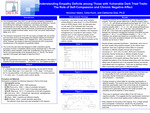
The Vulnerable Dark Triad (VDT) is a group of three related maladaptive personality styles: vulnerable narcissism (characterized as defensive, neurotic, and suffering from feelings of inadequacy), secondary psychopathy (characterized as chronically unstable, impulsive, and emotionally volatile), and tendencies of borderline personality disorder (BPD; characterized by unstable emotional states, sense of self, and social relationships) (Miller et al., 2011). The individual components of the VDT are substantially correlated with one another and have been found, in isolation, to be associated with empathic deficits (Grieve & Mahar, 2010; Salgado et al., 2020; Urbonaviciute, 2020). In the current two-part study, we will test two serial mediation models designed to better understand specific processes involved in empathetic deficits among individuals high in VDT traits. In the first model, we hypothesize that the negative relationship between the VDT and empathy occurs through the indirect path of self-compassion->self-concept clarity. The second model tested is identical to the first, but with negative emotion substituted for self-concept clarity as the second mediator variable. These hypothesized models are expected to be significant both when self-compassion, self-concept clarity, and empathy are examined as traits (Part 1) or within a specific situational context (Part 2).
Publication Date
4-23-2025
Project Designation
Capstone Project
Primary Advisor
Catherine Lutz Zois
Primary Advisor's Department
Psychology
Keywords
Stander Symposium, College of Arts and Sciences
Recommended Citation
"Understanding Empathy Deficits among those with Vulnerable Dark Triad Traits: The Indirect Effects of Self-Compassion, Self-Concept Clarity, and Negative Affect" (2025). Stander Symposium Projects. 3906.
https://ecommons.udayton.edu/stander_posters/3906

Comments
10:45-12:00, Kennedy Union Ballroom