

Presenter(s)
Connor Kurz
Files
Download Project (1.3 MB)
Description
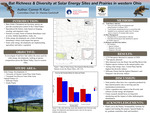
Solar energy developments are highly beneficial to renewable energy production, yet can fragment wildlife habitat and can affect sensitive mammal species, such as bats. Information on how bats are affected by renewable energy developments is well known for wind energy but very limited for solar energy. Ohio is home to 11 different bat species all with different traits, and all of them state protected. To better understand the response of bats to solar energy developments, we used acoustic monitoring techniques to record bat activity during the summer and fall at solar (n=5), forested (n=3), and prairie (n=3) sites. Bat activity was quantified using the number of passes per night and we used generalized linear mixed models to examine the relationship between activity and different environmental and site covariates. Using the same approach, we also examined species richness and diversity. Overall, we predict that solar energy developments will have a negative effect on bat activity and species composition compared to natural sites due to the reduced habitat complexity and therefore insect diversity. Our study will provide valuable insights on bat ecology in relation to sustainable energy and help inform on how to best mitigate and manage any impacts of these developments on bats in western Ohio.
Publication Date
4-23-2025
Project Designation
Graduate Research
Primary Advisor
Mariela Gantchoff
Primary Advisor's Department
Biology
Keywords
Stander Symposium, College of Arts and Sciences
Institutional Learning Goals
Scholarship; Community
Recommended Citation
"Response of Bats to Solar Energy Developments" (2025). Stander Symposium Projects. 3934.
https://ecommons.udayton.edu/stander_posters/3934

Comments
3:00-4:15, Kennedy Union Ballroom