

Presenter(s)
Sydney Herzog, Kelly McNamara
Files
Download Project (805 KB)
Description
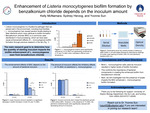
Listeria monocytogenes is a food-borne pathogen that is typically isolated in food environments. Benzalkonium chloride (BAC) is a common cleaner that is used in both medical and food-processing environments. How BAC impacts Listeria monocytogenes biofilm formation is not entirely known. Previous data from our lab has shown that concentrations of BAC higher than 0.1% enhances biofilm formation of Listeria monocytogenes. We hypothesized that bacterial lysing is the main reason for this enhancement. To test our hypothesis, we used different starting concentrations of Listeria monocytogenes culture and expected that higher bacteria inoculum would result in higher biofilm formation. Using a standard microplate biofilm assay and crystal violet staining, we showed a concentration-dependent formation of biofilm where higher amounts of Listeria monocytogenes led to higher biofilm formation, regardless if BAC was added. The BAC enhancement of biofilm formation was reduced with less L. monocytogenes inoculum. These results suggest that the bacterial abundance is a highly relevant factor in the effects of BAC on bacterial biofilm formation.
Publication Date
4-23-2025
Project Designation
Independent Research
Primary Advisor
Yvonne Y. Sun
Primary Advisor's Department
Biology
Keywords
Stander Symposium, College of Arts and Sciences
Institutional Learning Goals
Scholarship; Practical Wisdom
Recommended Citation
"Enhancement of biofilm in Listeria monocytogenes by benzalkonium chloride depends on the amount of the inoculum" (2025). Stander Symposium Projects. 3946.
https://ecommons.udayton.edu/stander_posters/3946

Comments
1:15-2:30, Kennedy Union Ballroom