

Presenter(s)
Brett Jones, Andrew Shoemaker, Charles Strunc
Files
Download Project (857 KB)
Description
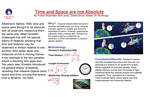
Before 1905, it was believed that time and space were absolute. Two observers will measure the same time and space regardless of the frame of reference where measurements are made. However, Albert Einstein challenged this long-held belief after introducing his well known special theory of relativity. This theory transformed how we view the universe as a whole. His theory shows that two observers would measure different times and distances when they move with respect to each other. In particular, time slows down and distance shrinks in moving frames. As an example, in our presentation we will discuss the twin paradox where we will show that the traveling twin will age less. Ten years later (1915), Einstein introduced his general theory of relativity where he shows that massive objects like planets and stars can bend space and time around them, affecting how the fabrics of space-time behave. This idea upends the traditional view of a constant, unchanging reality, showing instead that time and space are dynamic and interwoven in ways we’d never imagined before.
Publication Date
4-23-2025
Project Designation
Course Project - PHY 321 01
Primary Advisor
Mo Ahoujja
Primary Advisor's Department
Physics
Keywords
Stander Symposium, College of Arts and Sciences
Institutional Learning Goals
Scholarship; Scholarship; Scholarship
Recommended Citation
"Time and Space are not Absolute" (2025). Stander Symposium Projects. 3988.
https://ecommons.udayton.edu/stander_posters/3988

Comments
9:00-10:15, Kennedy Union Ballroom