

Presenter(s)
Kevin Johnston
Files
Download Project (1.9 MB)
Description
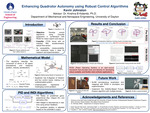
In the evolving landscape of unmanned aerial vehicles (UAVs), the autonomy and stability of quadrotors are crucial, especially in critical applications such as search and rescue missions and surveillance. This research focuses on the development and implementation of planning and control algorithms within the Robot Operating System (ROS2) framework. Initial work focused on developing Proportional-Integral-Derivative (PID) control algorithm in a realistic simulated environmental conditions, incorporating the effects of sensor noise. Following successful simulations, the study transitioned to real-world testing, validating the effectiveness of the proposed solutions in ROS2. The work conducted has not only demonstrated the practical utility of these algorithms in both simulated and real-world environments but has also laid the groundwork for more advanced applications in aerial robotics. The successful integration of ROS2 has opened up new avenues for modularity and scalability, critical for the ongoing evolution of autonomous drone technology.
Publication Date
4-23-2025
Project Designation
Honors Thesis
Primary Advisor
Dorian Borbonus, Krishna B. Kidambi
Primary Advisor's Department
Mechanical and Aerospace Engineering
Keywords
Stander Symposium, School of Engineering
Recommended Citation
"Enhancing Quadrotor Autonomy Using Robust Control Algorithms" (2025). Stander Symposium Projects. 4004.
https://ecommons.udayton.edu/stander_posters/4004

Comments
9:00-10:15, Kennedy Union Ballroom