

Presenter(s)
Megan Stoneburner
Files
Download Project (1.8 MB)
Description
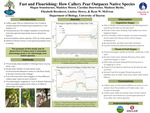
Callery pear (Pyrus calleryana) is an invasive woody species that threatens ecosystems in the eastern United States. This species was originally introduced to the United States as fire-blight resistant ornamental trees, and became popular due to the attractive flowers that are present from April to May that develop into fruits that stay on the trees for some of the winter. In the Miami Valley region, Callery pear is prevalent and aggressive in taking over niche space. Phenology is the study of the life cycle of a plant. In this study, we are focused on the phenology of Callery pear’s vegetative, fruiting, and flowering features. Callery pear is thought to have an extended phenology that allows it to outcompete native species in the area. The goal of this study is to give us a better understanding of Callery pear’s phenology in a changing climate. To obtain this goal, we established three study sites located in Montgomery County, Ohio, USA. These study sites were categorized as rural, urban, or suburban. Each of these study sites had five tagged Callery pear tree branches where vegetative, fruit, and flowering features were recorded on a weekly basis.We found that Callery pear begins to leaf out and buds earlier than similar native species. There was also evidence that some Callery pear trees flowered twice in a single growing season. These findings support our idea that Callery pear’s phenology is giving it an advantage over native species.
Publication Date
4-23-2025
Project Designation
Independent Research
Primary Advisor
Lindsey Christine Dewey, Ryan W. McEwan
Primary Advisor's Department
Biology
Keywords
Stander Symposium, College of Arts and Sciences
Institutional Learning Goals
Scholarship; Critical Evaluation of Our Times; Community
Recommended Citation
"Fast and Flourishing: How Callery Pear Outpaces Native Species" (2025). Stander Symposium Projects. 4050.
https://ecommons.udayton.edu/stander_posters/4050

Comments
3:00-4:15, Kennedy Union Ballroom