

Presenter(s)
Matthew Pochatek
Files
Download Project (304 KB)
Description
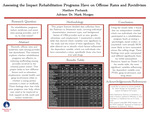
For this research project, I aim to explore various rehabilitation programs, with a focus on substance abuse treatment and mental health counseling, to assess their impact on juvenile recidivism. The primary research question I seek to answer is: Do rehabilitation programs reduce recidivism and arrest rates among juveniles, and if so, to what extent? The key outcome I intend to measure is the proportion of juveniles who, after participating in specific rehabilitation programs, either offend or re-offend. I will gather evidence of effectiveness for each rehab program and compare them. The independent variable in this study is the type of facility treatment received by individuals, such as mental health counseling or drug and alcohol rehabilitation. The dependent, or responding variable, is the recidivism rate among juveniles who have undergone treatment. Recidivism is defined as "a tendency to relapse into a previous condition or mode of behavior," and within criminology, it specifically refers to "the recurrence of criminal behavior, particularly following punishment"
Publication Date
4-23-2025
Project Designation
Capstone Project
Primary Advisor
Mark A. Morgan
Primary Advisor's Department
Criminal Justice and Security Studies
Keywords
Stander Symposium, College of Arts and Sciences
Institutional Learning Goals
Critical Evaluation of Our Times; Practical Wisdom; Diversity
Recommended Citation
"Rehabilitation programs and their effectiveness on reducing recidivism and arrest rates among juveniles" (2025). Stander Symposium Projects. 4052.
https://ecommons.udayton.edu/stander_posters/4052

Comments
9:00-10:15, Kennedy Union Ballroom