

Presenter(s)
Nahom Worku
Files
Download Project (1.1 MB)
Description
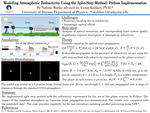
Understanding atmospheric effects requires accounting for atmospheric refractivity, the slowly varying large-scale component of the refractive index. Refractivity gradients can alter optical wave trajectories and introduce anisotropy effects. Standard wave optics approaches typically neglect these effects due to the complexity of their description, instead addressing refractivity impacts through ray-tracing methods. However, this simplification overlooks potential anisotropy effects caused by temperature gradients. Current descriptions of optical anisotropy remain ad hoc, and widely used non-Kolmogorov turbulence models lack predictive power in capturing these effects.This motivates a deeper investigation into the influence of temperature gradients—and consequently, refractivity distributions—on optical wave propagation in the atmosphere. As part of this effort, we developed a Python-based code based on the well known split-step technique to model refractivity effects. The refractivity is represented by the set of the phase screens. To validate the accuracy of our approach, we compared simulation results with published data. We conducted laser beam propagation simulations over distances ranging from 1 km to 10 km under standard US76 Atmosphere model conditions, considering an initial Gaussian beam with a 10 cm radius. The results demonstrated strong agreement with existing data. Additionally, we explored laser beam propagation in the presence of an Inverse Temperature Layer (ITL) with varying parameters, revealing significant laser beam intensity reshaping due to refractivity gradients.
Publication Date
4-23-2025
Project Designation
Independent Research
Primary Advisor
Victor A. Kulikov
Primary Advisor's Department
Physics
Keywords
Stander Symposium, College of Arts and Sciences
Institutional Learning Goals
Scholarship; Scholarship; Scholarship
Recommended Citation
"Modeling Atmospheric Refractivity Using the Split-Step Method: Python Implementation" (2025). Stander Symposium Projects. 4060.
https://ecommons.udayton.edu/stander_posters/4060

Comments
1:15-2:30, Kennedy Union Ballroom