

Presenter(s)
Aqsa Sultana
Files
Download Project (421 KB)
Description
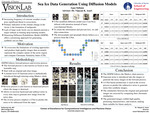
The increasing frequency of extreme weather events due to global warming poses significant threats to ecosystems and human life. One of the primary indicators of climate change in the Arctic is the formation of melt ponds on sea ice. However, the lack of large-scale, annotated Arctic sea ice datasets presents a major challenge in training deep learning models for predicting the dynamics of these melt ponds. In this study, we propose the use of diffusion models, a class of generative models, to synthesize Arctic sea ice data for the analysis of melt pond formation.Diffusion models generate realistic new data by learning the distribution of existing data and iteratively transforming a simple distribution into a more complex one through a noise-adding process. During training, noise (such as Gaussian noise) is added to the data, and the model learns how to reverse this process. After training, the model can generate new, realistic data by starting from random noise and gradually transforming it to match the distribution of the original data. During inference, the model uses conditioning information alongside the noise input to guide the generation of samples that adhere to specified conditions.For training the model, we used high-resolution aerial imagery from the Arctic region, collected during the Healy-Oden Trans Arctic Expedition (HOTRAX) in 2005, and NASA’s Operation IceBridge DMS L1B Geolocated and Orthorectified data from 2016. To evaluate the quality of the synthetic images, we employ the Chromatic Similarity Index (CSI), a metric for assessing chromatic similarity between the original and generated images. This approach demonstrates the potential of diffusion models for generating synthetic Arctic sea ice data to further understand melt pond dynamics.
Publication Date
4-23-2025
Project Designation
Graduate Research
Primary Advisor
Vijayan K. Asari
Primary Advisor's Department
Electrical and Computer Engineering
Keywords
Stander Symposium, School of Engineering
Recommended Citation
"Sea Ice Data Generation Using Diffusion Models" (2025). Stander Symposium Projects. 4138.
https://ecommons.udayton.edu/stander_posters/4138

Comments
3:00-4:15, Kennedy Union Ballroom