

Presenter(s)
Andrew Bumps, Rodrigo Del Rincón Martínez, Elizabeth Divish, Gretchen Sackman, Victoria Scachitti
Files
Download Project (1.8 MB)
Description
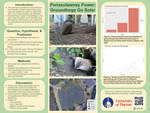
This study investigates the activity of groundhogs (Marmota monax) within the solar panel prairie of native grasses and wildflowers at Curran Place at the University of Dayton. The environment was split into three microhabitats where burrows were found: under the solar panels, in the aisles, and the buffer area. Six burrows were monitored over a two week period using motion activated cameras to determine if groundhogs had a preference of what burrow locations they used. It was hypothesized that burrows under solar panels would have the highest amount of activity (detections). Results showed that groundhogs show no preference between microhabitats and remain largely unaffected by the presence of solar panels. An ANOVA test found no statistically significant results, likely due to limitations such as time constraints, lack of replications, different camera angles, and uneven amounts of microhabitat cameras. The study concluded that groundhogs may not be significantly impacted by the presence of solar panels if other environmental factors are consistent.
Publication Date
4-23-2025
Project Designation
Course Project - BIO 452L M1
Primary Advisor
Connor Raynor Kurz, Chelse M. Prather
Primary Advisor's Department
Biology
Keywords
Stander Symposium, College of Arts and Sciences
Recommended Citation
"Punxsutawney Power: Groundhogs Go Solar" (2025). Stander Symposium Projects. 4163.
https://ecommons.udayton.edu/stander_posters/4163

Comments
10:45-12:00, Kennedy Union Ballroom