

Presenter(s)
Tom Jacob
Files
Download Project (140 KB)
Description
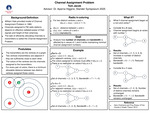
This is a project for MTH 466, Graph Theory and Combinatorics. A graph is a mathematical object that consists of two sets, a set of vertices and a set of edges. An edge joins two vertices and depicts a relationship between those vertices. By considering the vertices on a connected graph G of order n to be transmitters and the colors of the vertices to be the channels assigned to the transmitters, we can construct a model that represents the Channel Assignment Problem. This problem deals with the task of efficiently allocating channels to transmitters. Concepts such as radio k-coloring and radio labeling were inspired by the Channel Assignment Problem. By stipulating a minimum permitted distance rule, labeling vertices based on the assignment of their colors, and considering two vertices to be adjacent if they are sufficiently close to each other, it is possible to organize a network of channels that does not overlap each other. The Channel Assignment Problem has origins in assigning channels to FM radio stations through prevention of interference by keeping separation between stations based on signal power, height of their antennas, and frequency.
Publication Date
4-23-2025
Project Designation
Course Project - MTH 466 01
Primary Advisor
Aparna W. Higgins
Primary Advisor's Department
Mathematics
Keywords
Stander Symposium, College of Arts and Sciences
Institutional Learning Goals
Scholarship
Recommended Citation
"Channel Assignment Problem" (2025). Stander Symposium Projects. 4167.
https://ecommons.udayton.edu/stander_posters/4167

Comments
10:45-12:00, Kennedy Union Ballroom