
Presenter(s)
Kaitlin E. Boyd
Files
Download Project (87 KB)
Description
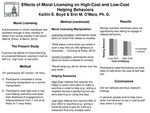
The present study examines the role of cost to self in moral licensing. Previous research shows that people who recall past moral behavior become morally licensed. That is, they are less likely to engage in future high-cost helping behaviors because they feel morally affirmed (Conway & Peetz, 2012). However, these findings are limited to contexts in which participants are asked their likelihood to engage in helping behaviors that are rather costly to the self (e.g., buying someone lunch). Thus far, research has not studied the effect of moral licensing on helping that is low in cost to the self (e.g., giving someone a few cents). Consistent with past research, it is predicted that moral licensing will lead to less helping in high-cost situations. Additionally, we are interested in whether the recall task also reduces helping in low-cost situations, or when the cost-to-self is low.
Publication Date
4-9-2014
Project Designation
Honors Thesis
Primary Advisor
Erin O'Mara
Primary Advisor's Department
Psychology
Keywords
Stander Symposium project
Disciplines
Arts and Humanities | Business | Education | Engineering | Life Sciences | Medicine and Health Sciences | Physical Sciences and Mathematics | Social and Behavioral Sciences
Recommended Citation
"Effects of Moral Licensing on High-Cost and Low-Cost Helping Behaviors" (2014). Stander Symposium Projects. 438.
https://ecommons.udayton.edu/stander_posters/438
Included in
Arts and Humanities Commons, Business Commons, Education Commons, Engineering Commons, Life Sciences Commons, Medicine and Health Sciences Commons, Physical Sciences and Mathematics Commons, Social and Behavioral Sciences Commons