

Presenter(s)
Maggie Reuter
Files
Download Project (219 KB)
Description
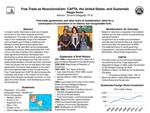
In today’s world, free trade is seen as a forgone conclusion in the march towards economic development. The origin of free trade agreements rests in the neoliberalist surge of the twentieth century based upon finding a middle ground between central planning and laissez-faire capitalism. As the twentieth century progressed, neoliberalism and the ideas associated with it fell more to the side of laissez-faire capitalism. Free trade agreements between developed and developing countries demonstrate a play of power on behalf of the developed countries that seems unfair. There are stories that are not told about free trade agreements. Economic data analysis in the years since the implementation of the Central America Free Trade Agreement (CAFTA) demonstrates the inequality that exists in the creation of free trade agreements between developed countries—in this case the United States—and developing countries like Guatemala.
Publication Date
4-9-2014
Project Designation
Honors Thesis
Primary Advisor
Simanti Dasgupta
Primary Advisor's Department
Sociology, Anthropology, and Social Work
Keywords
Stander Symposium project
Disciplines
Arts and Humanities | Business | Education | Engineering | Life Sciences | Medicine and Health Sciences | Physical Sciences and Mathematics | Social and Behavioral Sciences
Recommended Citation
"Free Trade as Neocolonialism: CAFTA, the United States and Guatemala" (2014). Stander Symposium Projects. 450.
https://ecommons.udayton.edu/stander_posters/450
Included in
Arts and Humanities Commons, Business Commons, Education Commons, Engineering Commons, Life Sciences Commons, Medicine and Health Sciences Commons, Physical Sciences and Mathematics Commons, Social and Behavioral Sciences Commons