

Presenter(s)
Ray Stallings
Files
Download Project (204 KB)
Description
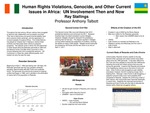
Throughout the last century, African nations have struggled to become fully independent and successful countries. Their development has been inhibited by the lack of democracy and governmental guidance within these nations. The United Nations has played an integral role in the development of these nations. This paper will take an in depth look at the actions of the UN in these situations and how they have changed or stayed the same over the past several decades. The paper will focus on two specific African nations that have struggled through human rights violations and genocide over the last twenty years. The focus of the paper will be to compare and contrast the UN’s actions in the 1994 Rwandan genocide and the Cote d’Ivoire Crisis of 2010. In both instances, the UN intervened to help diffuse the tension and help develop plans for the futures of these two nations. This paper takes a comprehensive look at which UN strategies worked, which strategies did not work, and how the UN can learn from these instances to help develop more successful practices and protocols for intervention in such instances in the future.
Publication Date
4-9-2014
Project Designation
Course Project
Primary Advisor
Anthony Talbott
Primary Advisor's Department
Political Science
Keywords
Stander Symposium project
Disciplines
Arts and Humanities | Business | Education | Engineering | Life Sciences | Medicine and Health Sciences | Physical Sciences and Mathematics | Social and Behavioral Sciences
Recommended Citation
"Research exercise: Human Rights Violations, Genocide, and Other Current Issues in Africa: UN Involvement Then and Now" (2014). Stander Symposium Projects. 463.
https://ecommons.udayton.edu/stander_posters/463
Included in
Arts and Humanities Commons, Business Commons, Education Commons, Engineering Commons, Life Sciences Commons, Medicine and Health Sciences Commons, Physical Sciences and Mathematics Commons, Social and Behavioral Sciences Commons

Comments
This poster reflects research conducted as part of a course project designed to give students experience in the research process.