

Presenter(s)
Christopher S. Morrow
Files
Download Project (1.0 MB)
Description
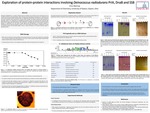
Deinococcus Radiodurans is a species of bacteria that has sparked a lot of interest since its discovery due to its incredible resistance to ionizing radiation. When exposed to ionizing radiation the genome of D. radiodurans will sustain several hundred double stranded breaks. D. radiodurans demonstrates the ability to repair its genome and restart replication after sustaining this, typically lethal, damage. This project examined the mechanism of replication restart in D. radiodurans by investigating primosome protein PriA interacting with DnaB and SSB. Many different types of gel electrophoresis were employed to investigate potential protein complex formations between D. radiodurans PriA and DnaB. Through agarose gel electrophoresis an interaction between D. radiodurans PriA and DnaB was identified. Results in this work indicate that although D. radiodurans PriA does not characteristically and functionally appear normal, it could still behave as we would classically expect in replication restart.
Publication Date
4-9-2015
Project Designation
Honors Thesis
Primary Advisor
Matthew E. Lopper
Primary Advisor's Department
Chemistry
Keywords
Stander Symposium project
Disciplines
Arts and Humanities | Business | Education | Engineering | Life Sciences | Medicine and Health Sciences | Physical Sciences and Mathematics | Social and Behavioral Sciences
Recommended Citation
"Investigation of protein-protein interactions involving Deinococcus radiodurans PriA, DnaB and SSB." (2015). Stander Symposium Projects. 587.
https://ecommons.udayton.edu/stander_posters/587
Included in
Arts and Humanities Commons, Business Commons, Education Commons, Engineering Commons, Life Sciences Commons, Medicine and Health Sciences Commons, Physical Sciences and Mathematics Commons, Social and Behavioral Sciences Commons