

Presenter(s)
Polly K. Long
Files
Download Project (175 KB)
Description
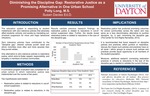
Across the nation, the education system is responding to student misbehavior with zero tolerance policies that parallel the punitive practices found in the juvenile and criminal justice systems. Zero tolerance policies have contributed to the “discipline gap,” wherein schools punish racial and ethnic minorities more often and more severely than they punish whites. One alternative to punitive punishment is restorative justice, which aims to foster respect, responsibility, and empathy in members of school communities. This project evaluates the relationship between restorative justice and out-of-school suspension rates in an urban school district. It also serves as one of the few studies that evaluate the effect of restorative practices on the discipline gap. The results validate previous research findings, as restorative justice is related to reductions in out-of-school suspension rates. Further, the results reveal a promising alternative to the punitive practices that plague the education system, as restorative justice is related to reductions in the size of the discipline gap.
Publication Date
4-9-2015
Project Designation
Graduate Research
Primary Advisor
Elana Bernstein, Susan C. Davies, Jamie Longazel
Primary Advisor's Department
Counselor Education and Human Services
Keywords
Stander Symposium project, School of Education and Health Sciences
Disciplines
Arts and Humanities | Business | Education | Engineering | Life Sciences | Medicine and Health Sciences | Physical Sciences and Mathematics | Social and Behavioral Sciences
Recommended Citation
"Diminishing the Discipline Gap: Restorative Justice as a Promising Alternative in One Urban School" (2015). Stander Symposium Projects. 617.
https://ecommons.udayton.edu/stander_posters/617
Included in
Arts and Humanities Commons, Business Commons, Education Commons, Engineering Commons, Life Sciences Commons, Medicine and Health Sciences Commons, Physical Sciences and Mathematics Commons, Social and Behavioral Sciences Commons