

Presenter(s)
Salahaldin Faraj Alshatshati
Files
Download Project (874 KB)
Description
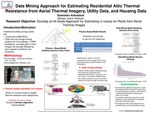
Conventional residential building energy auditing needed to identify opportunities for energy savings is expensive and time consuming. On-site energy audits require quantification of envelope U-values, air and duct leakage, and heating and cooling system efficiencies. There is a need to advance lower cost automated approaches, which could include aerial and drive-by thermal imaging at-scale in an effort to measure the building U-value. However, the thermal imaging approaches implemented to date, all based upon thermal-physical models of the envelopes, to estimate the U-values of walls require additional measurements and analysis prohibiting low-cost, at-scale implementation. This research focuses on interpreting aerial thermal images to estimate the U-value of roofs. A thermal-physics model of a ceiling is developed to show the difficulty in using the same approach used by others for walls, as new parameter estimates and thus more measurements would be required. A data-based methodology instead is posed. This approach integrates the inferred roof temperature measurement, historical utility data, and easily accessible or potentially easily accessible housing data. A Random Forest model is developed from a training subset of residences for which the ceiling U-values are known. This model is used to predict the roof U-values in a validation set of houses with unknown U-value. Demonstrated is an ability to estimate the attic/roof U-value with an R-squared value in the range of 0.96 using as few as 24 training houses. The implication of this research is significant, offering the possibility of auditing residences remotely at-scale via aerial and drive-by thermal imaging
Publication Date
4-18-2018
Project Designation
Graduate Research
Primary Advisor
Kevin P. Hallinan
Primary Advisor's Department
Mechanical and Aerospace Engineering
Keywords
Stander Symposium project
Recommended Citation
"Data Mining Approach for Estimating Residential Attic Thermal Resistance from Aerial Thermal Imagery, Utility Data, and Housing Data" (2018). Stander Symposium Projects. 1134.
https://ecommons.udayton.edu/stander_posters/1134