

Presenter(s)
Samantha L. Lonsinger
Files
Download Project (238 KB)
Description
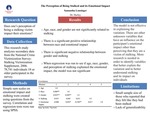
According to the Bureau of Justice Statistics, each year an estimated 14 in every 1,000 persons age 18 or older fell victim to stalking (Stalking). The impact that stalking can have on an individual has the potential to lead to a variety of mental health issues (Kilpatrick & Acierno, 2003). Victims of crimes such as stalking can experience extreme trauma which is one of the causes of depression. The mental health of victims needs to be studied so that effective counseling programs can be implemented across the globe. This project looks into the question, how does one’s perception of being a stalking victim impact their emotions? The hypothesis is that those who perceive the actions of others to be stalking will have a negative emotional response. The secondary data analyzed was pulled from the National Crime Victimization Survey: Stalking Victimization Supplement, 2006. The sample was a stratified multistage cluster sample that included 78,741participants. The correlation tests showed that whites are more emotionally impacted by the perception of stalking than non-whites and women were more emotionally impacted when they perceived that they had been stalked than men. More research is needed to develop a better understanding of the relationship between stalking and emotions.
Publication Date
4-22-2021
Project Designation
Capstone Project
Primary Advisor
Martha Hurley
Primary Advisor's Department
Criminal Justice Studies
Keywords
Stander Symposium project, College of Arts and Sciences
United Nations Sustainable Development Goals
Peace, Justice, and Strong Institutions
Recommended Citation
"The Perception of Being Stalked and its Emotional Impact" (2021). Stander Symposium Projects. 2175.
https://ecommons.udayton.edu/stander_posters/2175