
Presenter(s)
Lily Carolyn Behnke
Files
Download Project (362 KB)
Description
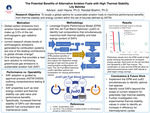
Sustainable Aviation Fuels (SAF’s) have proven to be a near term solution to minimizing net anthropogenic gas emissions produced by the aviation sector. While SAFs have the potential to achieve reductions in greenhouse gas emissions, their adoption is currently limited in part by the approval process (ASTM D4054) of developing fuels. Total energy content and thermal stability metrics of a potential SAF can add value and performance benefits. The metric of thermal-oxidative stability within the approval process measures the ability of a fuel to absorb heat without producing undesirable deposits. These coke deposits cause increased spread in exhaust gas temperature around the circumference of the combustor which in turn causes increased combustor emissions that negatively impacts turbine efficiency, and drives up CO2 emissions and fuel cost. Therefore, understanding the thermal stability metrics for SAF candidates is essential to reducing coking related airline maintenance costs, greenhouse gas emissions, and illuminating the full benefit of SAFs.
Publication Date
4-22-2021
Project Designation
Independent Research
Primary Advisor
Randall C. Boehm, Joshua S. Heyne
Primary Advisor's Department
Mechanical and Aerospace Engineering
Keywords
Stander Symposium project, School of Engineering
United Nations Sustainable Development Goals
Affordable and Clean Energy; Climate Action
Recommended Citation
"The Potential Benefits of Sustainable Aviation Fuels with High Thermal Stability" (2021). Stander Symposium Projects. 2380.
https://ecommons.udayton.edu/stander_posters/2380