

Presenter(s)
Aidan Augustus
Files
Download Project (577 KB)
Description
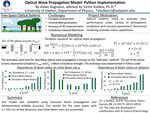
Optical systems are widely used in free-space communications, military defense, and remote sensing. Analyzing the impact of atmospheric effects on their performance requires the ability to model and adjust key propagation parameters, such as optical path length, turbulence characteristics, and system properties. Simulations provide control over environmental conditions and enable testing of various optical system configurations. Our laboratory research is focused on analyzing atmospheric optical effects to support applications such as the development of optical sensing instruments and the mitigation of atmospheric distortions affecting laser systems. This requires extensive simulations and analysis of optical wave propagation in the atmosphere. Current project aims for testing a developed software package and verifying its accuracy and modeling capability. We implemented the well-known split-step method for the numerical integration of the parabolic equation, modeling a turbulent atmosphere using a series of phase screens. To validate the code accuracy, we conducted laser beam propagation simulations over distances ranging from 1 km to 20 km, considering an initial Gaussian beam with a radius between 5 mm and 20 cm. Simulations were performed under both turbulent and non-turbulent conditions. The results align with analytical predictions in weak and medium scintillation regimes, where theoretical models provide solutions with reasonable accuracy.
Publication Date
4-23-2025
Project Designation
Independent Research
Primary Advisor
Victor A. Kulikov
Primary Advisor's Department
Physics
Keywords
Stander Symposium, College of Arts and Sciences
Institutional Learning Goals
Scholarship; Scholarship; Scholarship
Recommended Citation
"Optical Wave Propagation Model: Python Implementation" (2025). Stander Symposium Projects. 3907.
https://ecommons.udayton.edu/stander_posters/3907

Comments
9:00-10:15, Kennedy Union Ballroom