

Presenter(s)
Rebecca Sutton
Files
Download Project (116 KB)
Description
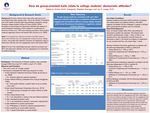
Typically, research suggests that age relates to political ideology such that youth are more liberal than older people (Glen, 1974). However, recent research suggests that the COVID-19 pandemic and social media have increased the popularity of right-wing ideology among European college students (Vinocur & Goury-Laffont, 2024). The present research aims to measure a similar phenomenon among American college students with particular attention toward group-oriented traits and democratic attitudes. Previous research shows that perception of government and democracy depends not only on political party affiliation, but also on traits and values. One influential trait is social dominance orientation (SDO), which describes one’s belief that their societal group surpasses other groups. Individuals high in SDO were found to prefer hierarchical power structures and be more conservative and less altruistic (Pratto et al., 1994). Another group-oriented trait that may predict civic engagement and democratic attitudes is collective narcissism, which describes extreme belief in the superiority of one’s group. Beside being related to outgroup aggression above and beyond SDO and right-wing authoritarianism (de Zavala et al., 2009), American collective narcissism specifically positively correlated with upholding racial inequality and negatively correlated with egalitarianism (Keenan & de Zavala, 2025). The current study will examine how collective narcissism and SDO relate to democratic attitudes and civic engagement among American college students. Our online survey will launch in mid-March 2025, and we aim to recruit 200 undergraduate participants enrolled in Psychology courses at the University of Dayton. In the survey, participants will complete a random order of predictor variables such as SDO and collective narcissism followed by a random order of outcome variables such as interest in voting and democratic attitudes. We predict that collective narcissism will negatively relate to democratic attitudes and civic engagement above and beyond SDO. We will also test if these relationships depend on political ideology.
Publication Date
4-23-2025
Project Designation
Independent Research
Primary Advisor
Joy E. Losee
Primary Advisor's Department
Psychology
Keywords
Stander Symposium, College of Arts and Sciences
Institutional Learning Goals
Critical Evaluation of Our Times; Scholarship; Practical Wisdom
Recommended Citation
"How do group-oriented traits relate to college students’ democratic attitudes?" (2025). Stander Symposium Projects. 4092.
https://ecommons.udayton.edu/stander_posters/4092

Comments
9:00-10:15, Kennedy Union Ballroom