

Presenter(s)
Moses Ayitey-Adjin
Files
Download Project (1.7 MB)
Description
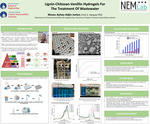
With the increasing number of contaminants found in wastewater, there has been a need to develop sustainable materials that will help address this issue. This work investigates the use of eco-friendly materials such as lignin, chitosan and vanillin in the formation of a hydrogel composite to help remove these pollutants from wastewater. Lignin a byproduct of the paper industry serves as an abundant and a source of a sustainable polymer, chitosan a biopolymer found in the exoskeleton of crustaceans is noted for its adsorption capacity. Vanillin, a natural crosslinker was also incorporated in the hydrogel matrix to improve the gel’s mechanical strength. Different hydrogel composites were synthesized in this work using lignin, chitosan and by varying the weight percent of the crosslinker vanillin. The various hydrogel composites were characterized using SEM, FTIR and a rheometer. The adsorption capacity of the hydrogels was also evaluated against water contaminants such as methylene blue. Preliminary results revealed that these hydrogel composite had high adsorption capacity and are able to remove contaminants such as methylene blue from wastewater hence a potential adsorbent for waste water treatment.
Publication Date
4-23-2025
Project Designation
Graduate Research
Primary Advisor
Erick Vasquez
Primary Advisor's Department
Chemical and Materials Engineering
Keywords
Stander Symposium, School of Engineering
Institutional Learning Goals
Community
Recommended Citation
"Sustainable Biopolymers for Water and Wastewater Treatment" (2025). Stander Symposium Projects. 3854.
https://ecommons.udayton.edu/stander_posters/3854

Comments
3:00-4:15, Kennedy Union Ballroom