
-

Medical Data Benchmarking for Recommender Systems
Rutuja Rajendra Nimbalkar
Patients with DCCs often experience multiple obstacles when prioritizing treatment plans and prescriptions. Discordant Chronic Comorbidities (DCCs) are health conditions in which patients have multiple, often unrelated, chronic illnesses that may need to be addressed concurrently but may also be associated with conflicting treatment instructions. Various machine learning (ML) or deep learning (DL) algorithms can provide treatment recommendations and identify drug interactions for patients with DCCs. However, to the best of our knowledge, we have yet to see a good documentation of how conflicting recommendations and evolving patient’s needs could be addressed using machine learning techniques. Further, there are no recommendations for algorithms situations for addressing these complex needs that patients with DCCs experience. And yet, the effective support of DCCs requires decisions aids that capture patients' concerns and preferences upfront, before suggesting a prescription recommendation. In this research, we first collected a data set consisting of the patient with DCCs concerns and prescription preference for each of their medical conditions (e.g., type 2 diabetes, arthritis, and/or depression). We then reviewed studies, models, and algorithms and tested some of these algorithms using a set of criteria with our dataset. And to set benchmark outcomes that can reveal the suitable algorithms, parameters, and testing criteria. Specifically, our research investigates four algorithms for identifying effective and efficient predictions of DCCs prescriptions, while taking into account patients' concerns and drug interactions. Among state-of-the-art supervised ML algorithms, Support Vector Machine (SVM) achieves the best performance. The best algorithms then integrated and deployed in the mobile application interface for user engagement and further evaluations.
-

Me in MEC? Why Students of Color at the University of Dayton Choose Whether or Not to to Utilize Targeted Resources on Campus.
Sebastian Michael Rawl
People of color in the United States have long been granted unequal access to educational opportunities which in turn has led to lower levels of achievement and higher drop-out rates when compared to their white peers. To combat this issue, many institutions of higher education, such as the University of Dayton, have created programs and offices which focus on improving outcomes for students of color as well as representing their cultures on the campus-level. The purpose of this research is to examine the reasons as to why or why not students of color on campus choose to utilize these types of resources and examine if these resources have benefited those students. In order to gain insight on these questions, students of color at the University of Dayton were asked to participate in individual interviews via online video-call to explore their experiences within the institution. This research provides a deeper understanding as to whether or not the university's efforts towards reaching and supporting students of color have been successful, as well as providing information which could influence future decisions.
-
Mental Health Among Army Reserve Officer Training Corps (ROTC) Cadets
Abigail Nicole Herrmann
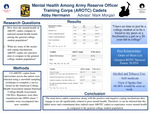
There is little research about the subgroup of Reserve Officer Training Corps (ROTC) cadets, especially none that focus on their mental health and the coping strategies they use to adjust to both the college atmosphere and military culture. Therefore, research will be conducted on Army ROTC cadets across the nation to better understand how the added pressure, commitments, and responsibilities affect cadets. The purpose of this project is to compare the mental health of Army ROTC cadets to national mental health trends among the general college student population to further explore some of the differences in this subgroup and learn how to help them better transition into these new environments. The participants in this study will be Army ROTC cadets across the nation. A survey will be distributed through social media outlets, especially through GroupMe chats and snowball sampling will be conducted to help expand the sample size and participation in this research study. The results from the survey will then be converted into percentages and compared to the data collected annually from the American College Health Association. Some of these findings may be categorized according to race, gender, age, and prior service to further evaluate groups who may be affected more while striving to integrate into both these cultures. These results will be used to help Army ROTC programs and college campuses across the nation better understand some of the difficulties this subgroup may be experiencing and use this information to develop more programs and resources to help ease the transition into both a college atmosphere and the military culture.
-

Military Service and the Expression of Amyotrophic Lateral Sclerosis (ALS)
William C. Johnson, Madison Kate Petschke
Amyotrophic Lateral Sclerosis (ALS), also known as Lou Gehrig’s Disease, is a neurodegenerative brain disease where the brain wrongly attacks its own motor neurons. Within 2-5 years of diagnosis, a patient with ALS will lose his/her ability to walk, speak, swallow, and even breathe on their own. This disease is very rare and there is currently no cure. This mysterious disease is caused 10% by inheritance, and 90% by other unknown causes. Some suggested causes based on instance of diagnosis might be age or sex, but the most interesting, suggested cause is history of military service. Is it because of chemical exposure, environmental factors, or the traumatic stress that soldiers endure? For our research project, we would like to further unravel the reasons behind ALS diagnosis, especially why the history of military service has a connection with the expression of ALS. We will also include an interview with Will’s roommate, whose father died from ALS in 2014.
-

miR-277 targets hid to ameliorate Aβ42-mediated neurodegeneration in Drosophila eye model of Alzheimer’s Disease
Anuradha Venkatakrishnan, Prajakta D. Deshpande
Alzheimer’s disease (AD), an age-related progressive neurodegenerative disorder, exhibits reduced cognitive functions with no cure to date. One of the reasons for AD is the extracellular accumulation of Amyloid-beta 42 (Aβ42) plaques. We misexpressed human Aβ42 in the developing retina of Drosophila, which exhibits AD-like neuropathology. Accumulation of Aβ42 plaque(s) triggers aberrant signaling resulting in neuronal cell death by unknown mechanism(s). We screened for microRNAs (miRNAs) which post-transcriptionally regulate expression of genes by degrading mRNA of the target genes. In a forward genetic screen with candidate miRNAs, we identified miR-277 as a genetic modifier of Aβ42-mediated neurodegeneration. Gain-of-function of miR-277 rescues Aβ42-mediated neurodegeneration whereas loss-of-function of miR-277 enhances Aβ42-mediated neurodegeneration. Moreover, misexpression of higher levels of miR-277 in the GMR>Aβ42 background restores the retinal axonal targeting indicating functional rescue. Furthermore, we have identified head involution defective (hid) as one of the targets of miR-277 by Fly TargetScan and validated by luciferase assay and qPCR. The hid transcript levels are decreased by ̴2.3-fold when miR-277 is misexpressed in the GMR>Aβ42 background in comparison to the GMR>Aβ42 fly model. Hence, here we provide a mechanism of how miR-277 modulates Aβ42-mediated neurodegeneration by regulating hid transcript levels and demonstrate its neuroprotective role in Aβ42-mediated neuropathology.
-

Mock Trial Team Presentation
Lydia G. Artz, Nicholas Alexander Gregor, Katherine Jean Hoener, Arabella D. Loera, Madeleine Elizabeth Onderak, Jackson Fryer Prieto, Sydney R. Sparks
Come watch the award-winning University of Dayton Mock Trial Team present their case: State of Midlands vs. Dakota Sutcliffe! Dakota Sutcliffe has been accused of committing aggravated arson for the burning of Chuggie's Sports Bar and the death of a local firefighter. Dayton Mock Trial will present portions of this case and answer any questions you might have. This will be a trial you won't want to miss!
-
Modeling Brownian Motion
Huseen KH. A. S. Alenezi, Abdulhadi A. H. J. Alqahtani, Abdullah M. H. J. Alqahtani
Brownian motion is the random motion of particles, atoms, or molecules that are because of random collisions of those particles. It is the motion of a particles such as a smoke or dust particle, in a gas, as it is buffeted by random collisions with gas molecules. Brownian motion can be observed physically as light shines through a window. Particles of dust or pollen can be seen in the light floating in the air and have random pattern of motion. The dust particles aren't moving on their own, but are colliding with molecules of the air keeping the dust in motion. Brownian motion is caused by the structure and physics of fluids i.e. liquids and gases. According to kinetic theory, all matter is in motion; atoms and molecules especially within liquids and gases are in constant vibrating motion. These particles will travel in straight lines until redirected by a collision. Particles within gases and liquids are constantly moving, colliding, and moving toward equilibrium. This kind of collision causes particles to have Brownian motion. In this project modeling of the Brownian motion is done through mathematical and programming tools.
-
Montessori Beyond Sixth Grade
Mary Koonce
Montessori methods of education stretch beyond formal teaching strategies to incorporate age-appropriate attributes of students into the curriculum. Montessori philosophical methods of education include a hands-on, self-guided approach to learning. Montessori schools typically range from pre kindergarten to the sixth. However, many students make the transition to non-Montessori schools at the start of the sixth grade. Some Montessori schools extend to middle and high school. This paper examines the experience of a Montessori middle and high school education and the impact on older students.
-
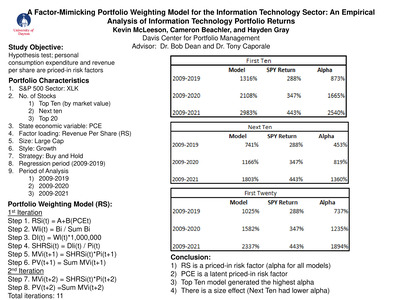
Multifactor Portfolio Weighting Models for the Consumer Discretionary Sector: An Empirical Analysis of Portfolio Returns, 2009-2021
Daniel Collins Montgomery, Paul Baraka Waweru
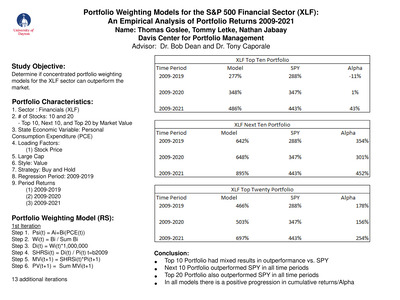
Discretionary Sector with consumer spending the "state " economic variable and revenue per shareand gross operating profit per share the principal factor loadings. We test the hypothesis that our portfolio weighting models outperform the market over the period 2009-2021.
-

Multifactor Portfolio Weighting Models for the Health Care Sector: An Empirical Analysis of Portfolio Returns, 2009-2021
Patrick James Burns, Alec W. Gizzie, Julia Catharine Reinker
We construct portfolio weighting models for the S&P 500 Health Care sector with consumer spending the "state" economic variable and revenue per share and gross operating profits per share the principal loading factors. We test the hypothesis that our portfolio weighting models outperform the market over the period 2009-2021.
-
Multi-Robot Path Planning with Collision Avoidance
Mohammad Zainullah Khan
Integrating robotics into manufacturing tasks is now a decades-old practice with ongoing advances making robotics faster, cheaper, and more accurate on an almost daily basis. Individually, robots have become highly effective at performing tasks in isolation. The goal of this research is to advance automatic path planning for multiple robot agents to intelligently and cooperatively accomplish manufacturing tasks in close proximity. These robots can range from simple robot architectures to several 6-DOF articulated arms on mobile bases to be used for spray coating, pressure washing, media blasting, and sanding. These applications are low-volume, high-mix manufacturing environments where task variability renders human programming impractical. While addressing the possibility of collisions for multi-agents, practical manufacturing constraints also need to be considered. In additive manufacturing, for example, it is important that each raster be completed by a single agent to prevent undesirable tool retracts that will affect print quality. The methodology for addressing this research includes the development of optimization models that simultaneously incorporate both manufacturing process constraints and the manipulator's kinematics and collision constraints. This project proposes to develop coordination planning techniques for N overlapping robot architectures composed of 3 or more revolute and/or prismatic joints.
-

Navigating Burnout in Student Affairs Graduate Students
Meg L. Austin
As graduate students begin to enter the higher education and student affairs field, they are socialized to navigate their work successfully, which often includes over-involvement and over-commitment (Allen et al., 2020). Previous studies on student affairs burnout found that intense workloads, low salaries, conflicts between work and personal life, lack of advancement, and lack of continued passion contributed to burnout (Marshall et al., 2016; Mullen et al., 2018; Naifeh, 2019). Although there is a plethora of research on burnout and stress in student affairs professionals, research around student affairs graduate students is mostly absent. The purpose of this study is to discover how current full-time student affairs graduate students who hold assistantships navigate burnout, what factors cause burnout for graduate students, as well as the impacts of burnout before they obtain a full-time student affairs job. Data has been collected through qualitative research, interviewing 11 current full-time student affairs graduate students with graduate assistantships. Data shows that graduate students experience burnout due to lack of personal-professional boundaries, low-pay, and lack of support or recognition. These results can help the student affairs field positively impact retention rates, transform the culture of the profession, and better support graduate students.
-
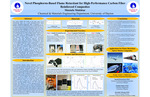
Novel Phosphorus-Based Flame Retardant for High-Performance Carbon Fiber Reinforced Composites
Mustafa Mukhtar
This study aims to determine the initial performance of a novel phosphorus-containing epoxy monomer that could be incorporated into conventional epoxy (DGEBA) formulations to produce high-performance carbon fiber epoxy composites with little or no compromise in processing, treatment, and mechanical characteristics. This poster outlines the results of an experimental study on a novel phosphorus-based flame retardant (Phosphorus-Diglycidyl Ether of Bisphenol A) (P-DGEBA), which was synthesized at U.D. and then blended into a traditional epoxy-amine resin formulation. Differential scanning calorimetry (DSC) was used to evaluate the curing behavior of P-DGEBA with epoxy resin. Thermogravimetric analysis (TGA) was also used to investigate the thermal stability and thermal degradation behaviors of the P-DGEBA/DGEBA blends. The micro-combustion calorimeter (MCC) test results confirmed that 50% P-DGEBA was the optimal percentage for balancing the performance (low heat release, high char yield) and minimizing the use of the available material, which was in scarce supply. Next, a composite fabrication technique was developed to incorporate the P-DGEBA into woven carbon fiber laminates with minimal waste of the synthesized monomer. The panel fabrication approach successfully produced panels using the autoclave technique that meets aerospace quality specifications with a Vf of around 0.5, which is an acceptable result for a panel manufactured to form a woven carbon fabric. The findings of dynamic mechanical analysis (DMA) on composite coupons showed that the Tg of the baseline panel was 72 °C, while the Tg of P-DGEBA-containing panels was about 78 °C. According to Cone calorimeter results, P-DGEBA produced less heat while increasing smoke generation and lowering the effective heat of combustion. Interestingly, the inclusion of P-DGEBA in DGEBA resin composites reduced their flammability by up to 28% without degrading their mechanical qualities by raising the mixture's glass transition temperature.
-

ODW Logistics Truckload Cost Modeling
Warith Ali Nasser Mohammed Al Wardi, Andrew Rowland Brucken, Mary L. Burrows, Marc Craine Daly
This project researches the opportunities to improve efficiency and reduce costs associated with product logistics
-

Ohio Health Enterprise (PMO)Development of a MS Teams Project Management Toolkit
Samuel Bowman Harris, Khalis E. Hicks, Daniel Honquest, Megan Marie Moore
This project will create a "Tool Kit" of software tools/templates/processes within the MIS Teams software system to aid in the management of company projects. This tool is intended to help non project management professionals who are occasionally asked to manage a project within their own work area or department. This tool in not attended for larger projects which are best managed by the companies EPO (Enterprise Project Office).
-

Oklahoma SB 1470 and its Human Rights Implications
Ryley Goles, Grace K. Hughes, Jacob E. Lunsford, Naumann
Oklahoma’s Senate Bill 1470, titled the “Students’ Religious Belief Protection Act,” disproportionately silences students and employees in the Oklahoma public school system that are part of a religious minority. The bill states that Oklahoma public school employees cannot promote or teach ideas that contradict students’ religious beliefs. In addition, employees are subject to fines and/or termination for violating this bill. This legislation, if passed, would directly violate the Universal Declaration of Human Rights and the First Amendment by suppressing freedom of thought and speech. This bill comes as one of a number of bills across the country that aim to control what is taught in schools. This piece of legislation holds the potential to change what is taught in schools and how certain controversial topics may be portrayed – or even silenced. This bill could create a snowball effect that leads to more legislation further limiting educators and suppressing instruction on certain topics. Ultimately, it could result in states controlling what and how students learn about certain topics.
-

Open-source Stereo Digital Image Correlation Optimized for Large Deformation Soft Materials Testing: Development and Validation
Joseph G. Beckett
Stereo digital image correlation (DIC) is an optical measurement technique capable of producing contour plots of 3D deformations. These rich measurement capabilities – namely, the ability to capture local shape and volume changes in specimens undergoing complex 3D deformations during mechanical testing – make DIC a compelling research tool for characterizing the mechanical properties of numerous classes of materials. Soft materials, which typically exhibit large strains at fracture, present several major challenges to DIC measurements including pattern breakdown, saturated image regions from glare, and large fields of view. In this research, a DIC system is designed to overcome these obstacles in a cost-effective manner using commercially available equipment and Digital Image Correlation Engine (DICe) open-source processing software. High-aspect-ratio image sensors, cross polarization, and custom DIC patterning stamps are utilized to improve DIC imaging quality for soft materials testing. The system’s extensive validation is discussed to demonstrate the system’s ability to yield repeatable and accurate data and to identify current limitations of the system.
-

Opioid Epidemic Waves
Chase Alexander Hoffman, David A. Somodi
In 1999, Ohio saw only 327 overdose deaths. As of 2020, the number reported by the Ohio Department of Health was over 5000 deaths (Ohio University, 2021). The opioid epidemic can be traced in three significant “waves” as identified by the CDC: 1990s due to the over prescription of opioids, 2010 due to a rapid increase of overdoses involving heroin, 2013 due to the illicit production of fentanyl and its addition to heroin. As a result of the over prescription of opioids, new prescription laws in Ohio required physicians and pharmacies to log controlled substances into a database starting in 2006. Although there were new laws and regulations that were put in place, there was still rising cases of opioid overdoses. Additionally, there were significant cases of fentanyl being found in illicit drugs in lethal dosages. Currently, Fentanyl-related fatalities account for almost four out of five opioid overdose deaths (Georgetown Hospital 2021). Rehabilitation services are crucial to combatting addictive behaviors. During the pandemic, rehabilitation services addressing addiction were indefinitely suspended. As a result of this and other stresses that the pandemic placed on individuals and families, there was a significant rise in overdoses in Ohio (Perry, 2021). This poster explores the effect all these had on overdose deaths to determine which factors should receive the most attention.
-
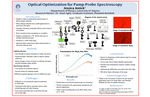
Optical Optimization for Pump-Probe Spectroscopy
Jessica A. Jenick
One important technique for materials characterization is that of pump-probe spectroscopy, which allows us to understand the interactions and characteristics of excited materials under light illumination. The goal of this project was to design and build a pump-probe optical setup for single shot spectroscopy of phase change materials. This setup requires that a sample be pumped by a blue laser to instigate thermal processes, and then probed by a white lamp to look for the spectral shifts as a function of time and optical power. Through the careful use of lenses and mirrors, we were able to refine our optical setup to get acceptable power levels and useful spot sizes to match a white light probe beam with a blue light pump. We have been able to overcome difficulties regarding the use of a white lamp with poor spatial coherence. Building on what has been learned through building this initial setup, we will be able to improve it over time. This setup can later be used with the spectrometer built by the physics department for the further experimentation.
-

Optical Study of the Topological Semimetal Bi4Se3
Margaret Brown
Quantum confinement of the topological semimetal Bi4Se3 was observed as a giant enhancement of the optical bandgap in two characteristic length-reducing regimes: ultra-thin films and nanoplatelets. The films were prepared via DC magnetron sputtering and characterized using atomic force microscopy and ultraviolet-visible spectroscopy. Current work investigates correlations of reduced dimensionality to enhancements of the bandgap. By characterizing the dimensionality through microscopy, spectroscopy results can be mapped to changes in the band edge as determined through Tauc plots.
-

Optimization Protection Coordination for Smart Microgrid
Uchenna Nwaichi
The increasing penetration of renewable energy resources into the power grid presents many challenges in terms of optimizing grid performance and ensuring effective operation. In the particular case of islanding microgrids, the coordination of microgrid protection schemes to provide adequate system protection during grid-connected fault conditions and to seamlessly accommodate the transition to islanded operation is of significant interest. Several recent studies have explored this problem characterizing the different fault regimes evident in islanded operation, and numerous approaches to resolving these challenges have been proposed ranging from adaptive protection methods, differential current methods, voltage droop and harmonic distortion approaches, and phasor-based and travelling wave methods. New approaches to this problem continue to be explored and some recent reports have demonstrated effective operation on model systems. In a robust microgrid with multiple sources, optimization of the microgrid protection scheme is necessary to avoid miscoordination due to the possibility of changes in microgrid load or power flow. In this work a smart approach of fault isolation and system protection using circuit segmentation is proposed. A mathematical model of the protection scheme is developed, and a coordinated protection system is designed with redundancies to ensure protection in the event of device failure. Optimization methods are explored where an objective function is minimized using, water cycle, particle swarm, genetic, simulated annealing and pattern search optimization algorithms. The design approach seeks to minimize the protection response time, minimizing the time from fault detection to system segmentation and isolation. A comparative assessment of the overall performance of the listed optimization approaches is presented based on performance metrics such as operating time and solution convergence.
-

Oscillating Chemical Reactions
Ali H. K. M. Alenezi, Michael Jude Johnson, Mitchell A. Manzardo
When looking at the Belousov-Zhabotinsky reaction we find that if we add an indicator to the chemical reaction that changes depending on the concentrations of the chemical we can watch as the mixture changes back and forth from two different colors. We plan on representing this chemical reaction and the color change during our presentation.
-

Our Lady of Pellevoisin
Jacqueline Rose Kasner
Estelle Faguette was a French servant who was in the hospital dying of tuberculosis when she saw Mary appear to her, rebuking a demon. Mary would continue to visit Estelle for five days, eventually curing Estelle from the disease. After Estelle was cured, Mary would continue to visit her ten more times before her death in 1929. Estelle's faithfulness has allowed for a new Scapular of the Sacred Heart, and shrines of Our Lady of Pellevoisin in New York, NY and McIntosh, Ont, indicating the apparition has an impact not just in the small village of Pellevoisin, France, but also around the world as well.
-

Permeability measurement of 3D-printed controlled-porosity deltoid inserts for composite T-joints
Khalid Aldhahri
Liquid Composite Molding (LCM) processes are one of the most common ways to produce composite material structures for various high-performance industries, especially for aerospace applications. LCM processes include resin transfer molding (RTM) and vacuum assisted RTM (VARTM). A key challenge with the LCM process is how to fully impregnate the dry fiber preform with resin inside the mold. Limited research has been conducted to investigate the resin flow behavior in critical regions of complex geometry, such as the junction between the flange and web in T-joints (referred to as a deltoid). This area is very important to the structural integrity and long-term durability of the T-joint, yet it is often ignored, leading to a resin-rich area. This study describes initial work aimed at producing custom-designed deltoid inserts with controlled porosity using additive manufacturing. Two different porosity geometries were developed, and deltoid shapes were produced with each one. The density for each porosity type was parametrically varied from 30%–70% solid (infill density). This presentation will present and discuss the permeability measurements made for each one in the three principal directions (K1, K2, K3). The 3D printed insert will have a porosity that can optimize resin flow, while simultaneously providing perfect geometric support for the plies of fabric that come together in this region.
-
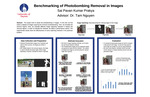
Photobombing Removal in Images
Sai Pavan Kumar Prakya
The project aims to tackle the photobombing in images. To this end, we first collect a dataset of images requiring the removal of photobombing. Then, we annotate the removal regions. Next, we evaluate different image inpainting methods to replace the removal regions. In order to evaluate the methods, we define a performance metrics. The experimental results show the effectiveness of some inpainting methods in this particular problem.
The Brother Joseph W. Stander Symposium recognizes and celebrates academic excellence in undergraduate and graduate education. This annual event provides an opportunity for students from all disciplines to showcase their intellectual and artistic accomplishments and embody the University's mission to be a "community of learners." This collection contains a sampling of the more than 200 projects presented each year during the symposium.
Printing is not supported at the primary Gallery Thumbnail page. Please first navigate to a specific Image before printing.