

-
College Selection Process: Does Faith of an Institution Influence the Decision-Making?
Anna R Parks
The University of Dayton is one of three Marianist universities in the country. This quantitative survey-based study explores whether or not there is a correlation between the religious affiliation of an institution and the college decision-making process. The purpose of this study is twofold: (a) to determine the common factors that go into the college search process and how important they are to students and (b) to evaluate the influence that the Marianist traditions at the University of Dayton had on students when determining a university to attend. The findings of this survey provide knowledge for how the institution can best recruit students and share what they find to be most important in the college search process with them about the University of Dayton.
-
Effects of Police Interaction on Student Perception of Police and Campus Safety
Jerami Paul Johnson
This research seeks to understand the effect of police interaction on student perception around campus police and safety. Data was collected from two Midwestern institutions, one being a traditional 4 year residential campus and the other a community college. The study was conducted using a standard survey. The survey includes Likert-scale questions asking students to rank their feelings regarding their campus police officers as well as how students engage with these police officers. Students also identified alternate safety measures or protocols they utilize in lieu of police officers, based on their perceptions.
-
Entering the Brotherhood: Men of Color’s Experience in Historically White Fraternities
Joseph J Moore
This study seeks to understand the experiences of undergraduate men of color after they gain membership with a historically white, North American Interfraternity Conference fraternity. The significance of this study is derived from the lack of prominent research involving men of color and membership with historically white fraternities. This research allows for the advancement of the Fraternity and Sorority Life field by shedding light on a population of students that is misunderstood and in turn impacting the way professionals interact with students. This research study speaks to the intersection of both the male and student of color identity within the context of historically white fraternities by highlighting the lived experiences of those members. This study collected data through individual interviews with alumni members allowing for a deeper look into the subjects’ experiences. This study speaks to the lived experiences of the subjects’ around the themes of motivations to seek membership, experiences gaining membership, living in community, racial impact on experience, sense of belonging, senses of community and feeling othered.
-
Exploring College Roommate Conflicts
Brittany Ann Fishburn
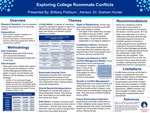
The conversation surrounding roommate conflicts has already begun, but a majority of past literature has focused on personal characteristics of individuals and their compatibility as roommates. Quantitative research studies have delved into how it impacts the lives of students, including stress, mental health and retention. Yet empirical research has not yet been conducted specifically on the actual dynamics of interpersonal conflict between college roommates. The purpose of this qualitative study is to better understand the experiences of college roommates in conflict at a private, Midwestern institution and how they respond to the phenomenon. With the desire to put student experience at the center of this research, students’ perceptions were shared through semi-structured, in-person one-on-one interviews with the individuals who self-selected to take part in this study. Expressly, this research provides a richer understanding of how roommates react to conflict based upon how nonverbal and verbal reactions within the conflict situation are expressed, what conflict resolution strategies roommates generally use in conflict and how roommates in conflict describe how it has shaped their capacity for coping with the inevitable conflicts of the future. With mental health and overall college satisfaction on the line, this research assists student affairs practitioners in better understanding the dynamics between roommates in conflict and how it shapes their college experience. It provides insight into how student affairs practitioners, especially those who work in university housing, can be better prepared to respond to situations where roommates are in conflict. Inevitably, this information can lead to the creation of better conflict management practices to teach to staff and students in university housing and across campus.
-
Extrinsic Factors of Academic Probation Attrition of Engineering Students
Luke Austin Matulewicz
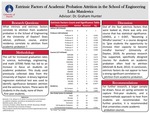
Being on academic probation is a stressful time for students. Many programs have been designed to specifically help these students return good academic standing; however, there is mixed success. Academic probation can often lead students to taking an extra semester, delaying their graduate, and/or not finish their degree—all of these causing an issue with retention and graduation rates. There has been an increased focus on a workforce with a science, technology, engineering, and math (STEM) education over the years, making it imperative to colleges and universities to effectively graduate their STEM students. This quantitative data analysis looks to examine extrinsic factors, factors out of the students’ control, of students on academic probation in the School of Engineering at the University of Dayton and the correlation to academic attrition. Using mined university data, this research uses statistical tests to find significate factors of attrition from academic probation.
-
Faculty Perceptions of Preparedness in Leading Short-Term Education Abroad Programs
Kelly N Plazibat
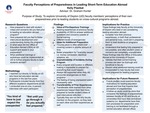
Faculty who lead education abroad programs are experts in their academic field, but may or may not feel as equipped to handle the additional responsibilities that come with leading a study abroad program apart from teaching their course content. This is a qualitative research study examining faculty perceptions of their own preparedness prior to leading college students on short-term education abroad programs. Through interviews with faculty members from various departments at the University of Dayton, they were asked to reflect on their experiences with the following: Managing student crisis, conflict and concerns; facilitating intercultural dialogue and reflection; and takeaways from pre-departure trainings facilitated by the Office of Education Abroad prior to leading students on programs abroad. My interpretation of the data suggests faculty overall felt prepared due to previous life experiences both inside and outside the experience of being a university faculty member, but that many education abroad programs seem to present unforeseen emergencies or situations that one could not possibly have anticipated or prepared for prior to departure.
-
How Representation During a College Visit can Influence a Student of Color’s Decision to Attend a Predominately White Institution
Deidre Danielle Luckett
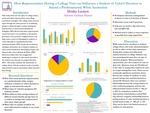
Students attend campus visits hoping to gain an understanding of what universities can offer them as students. Universities have shifted their focus to creating visitation experiences where students feel a sense of belonging before they even apply. Due to the growing understanding of the positive influence of representation, many schools are beginning to showcase campus diversity through various multicultural visitation experiences and making stronger efforts to include diverse groups of students (Boyington, 2017). The purpose of this quantitative research study is to examine how students’ decision of college choice is influenced by the racial/ethnic representation present during their college visit at a predominately white institution. A survey was distributed to current undergraduate students of color at the University of Dayton to reflect upon their experiences during their college visit and how the presence of other students of color, faculty, and staff contributed to their decision to attend the University of Dayton and their overall sense of belonging. This study combines the frameworks of college choice with the students’ needs of positive representation and an environment where they feel they belong.
-
Impact of a Catholic and Marianist University Experience on Career and Education
Anna Kathleen Wilhelm
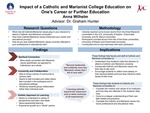
A number of students choose to attend religious universities based on their personal beliefs, or faith practices that they hope to further develop while in college. However, the particular values or skills established during college may or may not continue to manifest themselves as individuals advance in their careers or education. The purpose of this study is to explore the impact of a Catholic and Marianist university experience on one’s career and/or further education. More specifically, we aim to learn more about how alumni of Marianist universities in the United States feel that their Catholic and Marianist education has influenced their career journey and/or experience in earning additional degrees. This qualitative study includes interviews with alumni of Catholic and Marianist universities in the United States and seeks to determine the impact of their Catholic and Marianist college education on their careers and further education. Insights from this study can be used to inform practice specifically at Catholic and Marianist universities, as students prepare for their careers and/or further education.
-
Motivation Indicators of Involved Commuter Students at the University of Dayton
Alysha K Rauen
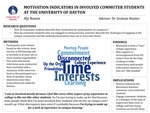
The purpose of this qualitative, phenomenological study is to understand the motivations of commuter students in universities and colleges in the United States who get involved in co-curricular activities, such as recognized student organizations. This study will increase the already very minimal amount of research on commuter students on college campuses and will provide insight that has not been addressed. Understanding these motivations will help professionals better understand this population of students and be able to improve practices to better address their needs. Data was collected through in person interviews (n = 5) between the researcher and students who fit the criteria of being a commuter students and involved in at least one recognized student organization. Themes that emerged from the data were that commuter students are self-motivated to get involved and the distance of their commute does not affect their motivation.
-

Place-Based Community Engagement and the Development of Self-Authorship in Undergraduate Women of Color
Ajanti Simone George
A central goal of higher education professionals is to promote self-authorship within the students that they serve; that is, helping students develop their internal capacity for discerning who they are in relation to their identity, values and social exchanges. Place-based community engaged learning challenges colleges and universities to assess the degree to which their espoused values of citizenship and activism at the institutional level are aligned with their actions; it is a multi-layered approach that requires institutions to reexamine policies that are rooted in oppression and maximize reciprocity. Understanding the historical context surrounding a university in relationship to community engaged efforts is especially important as institutions pursue racial equity and a more diverse student body. More specifically, understanding the experiences of women in color in higher education is key to uncovering the ways in which their racial identity plays a role in their unique interpretation of community engaged efforts and how they subsequently learn to negotiate their own values and beliefs rather than assimilate to the majority. The purpose of this qualitative phenomenological study is to better understand the impact that participation in place-based community engagement has on the development of self-authorship in self-identified undergraduate women of color at the University of Dayton. Grounded in the constructivist paradigm, this study is intended to further the profession’s knowledge about how practitioners can partner in student learning as they grow in their own awareness of self, with a nuanced understanding of a diverse sub-population.
-
Self-Authorship and Queer Students of Color
John Lewis McGee
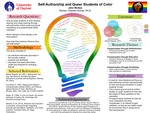
Self-authorship is an important concept which allows higher education professionals to see the development of students and how students make meaning and create relationships. Higher education for years has failed to examine queer students of color, grouping them under an operative assumption, which assumes that they develop the same way students of color or queer students do. This failure to recognize the intersections of racial and sexual identities has led to the lack of literature written and exploration of queer students of color and self-authorship. The purpose of this study is to explore the extent to which queer students of color develop self-authorship at predominantly White Institutions. Grounded in the constructivist paradigm, using the narrative inquiry, this study describes the cognitive, interpersonal and intrapersonal experiences of queer students of color in the Midwest. As this study demonstrates, intersectionality plays a critical role in how students identify, make meaning and create relationships often involving the feeling or a need to overcompensate in other aspects of life.
-
Serving the 6%: First Generation Students in a Multigenerational Campus Environment
Ashantice De'Oun Johnson-Knox
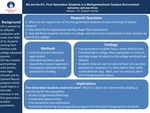
First generation college students (FGCS) often face hardships throughout their college experiences, from matriculation to graduation. The FGCS population is growing every year, which increases the urgent need to properly serve them. The University of Dayton is known for making their students feel at home on their campus. Although FGC students currently represent only 6% of the undergraduate student population at the University of Dayton, the university will soon be seeing an increase in this student population with the addition of Flyer Promise and the UD-Sinclair Academy. The demand for services and resources that fit the needs of these students will become increasingly urgent. By utilizing interviews with five current first-generation students, this study highlights the ways in which FGCS navigate an unfamiliar campus environment.
-
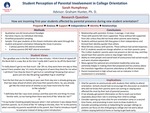
Student Perception of Parental Involvement in College Orientation
Sarah Kathryn Skidmore
Much research on orientation focuses on how parental involvement affects retention or overall first-year student success in college. However, there is a lack of research focusing on orientation solely and what happens to students if parents are or are not able to attend with the student. This study uncovers just that, allowing for a shift in focus from retention to the emotional side of a student and how having one or both parents present may or may not affect their emotional transition into college. Orientation is the time where students and families are given as much information as possible to feel prepared for the start of this new journey. The experience can make or break a student’s perception of their new college home, and having parents there adds another whole dimension to a student’s feelings of comfort and support. Through a qualitative, narrative approach, this research delves into the lives of five students who did and six students who did not have parents present at orientation. Students reflect on their perceived levels of anxiousness, preparedness, support, autonomy and independence, ability to meet people, and their space to develop identity and self-authorship all in relation to whether or not their parents were able to attend orientation with them. This study helps student affairs professionals better understand what affect parental presence at new student orientation has on incoming students. It helps institutions decide whether to have more or less parent sessions during orientation. It also helps institutions see how students are feeling when they do not have a parent present, possibly suggesting ways that institutions can provide opportunities for these students to have sessions that still allow them to feel that same type of support as students whose parents were present.
-
The College Student Perspective on Reintegration
Emily Katherine Dotson
Many institutions of higher education are finding the likelihood of students returning to the university after a disciplinary suspension is somewhat higher than in past decades. Students who return have different stories and experiences that are important to any reintegration to a community. Restorative Justice practices can play a large part in making someone feel accepted, forgiven, and allows for rebuilding relationships. Between work done in prisons or in K-12 schooling, reintegration programs can look extremely different. Through semi-structured interviewing four (4) students at the University of Dayton who have successfully reintegrated to the community, I explored their perspective on what is most and least helpful during their reintegration experience. Results show that having a reintegration program significantly aided students in feeling more welcomed back to campus and ensured that they continued on a path for success concurrent with their personal goals. In future practices, schools should create a reintegration program that is more uplifting and positive such as Restorative Justice Practices, versus a punitive approach causing a further decline in student and staff relations. Having support and resources readily available at the beginning has shown to be the most beneficial for returning students.
-
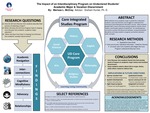
The Impact of an Interdisciplinary Program on Undeclared Students’ Academic Major Choice and Vocation Discernment
Marissa L McCray
While selection of an academic major is pivotal for undeclared students, many lack direction and struggle to understand the meaning of prescribed, seemingly unrelated general education courses traditionally required in the initial college curriculum. Moreover, many undeclared students grapple with a sense of calling or purpose among academic choices, future careers, and broader facets of emerging adulthood. An interdisciplinary curriculum counters the disconnect between compartmentalized disciplines and helps students recognize connections between disciplines and wider contexts. The purpose of this qualitative case study is to explore how the University of Dayton Core Program shapes undeclared students’ academic major selection and vocational outlook. This study examines Core students who began the program as Discover Arts (undeclared) and evaluates how Core shaped their academic major selection and vocation discernment. Qualitative data was collected from one-on-one interviews with junior Core students who recently completed the 2 ½ year interdisciplinary program. Findings revealed numerous themes and patterns surrounding the academic major selection process and the impact made by the Core Program during discernment. This study assesses future implications for continued best practices and seeks to address a gap in the literature about the influence of interdisciplinary curricula on undeclared students’ choices about academic major and vocational outlook.
-
The Impact of Home and College Tension on Grit in First-Generation College Students
Kaley Lynn Meyer
In the context of higher education, students who have parents with postsecondary degrees have an advantage over those who are first in their families to attend college. One of the most commonly discussed challenges for first-generation students is navigating the tension they experience from living lives in two different worlds: life at home and life at college. Interestingly, however, some literature illuminates how the unique challenges first-generation students face often make them more determined, persistent, resilient and prideful in their collegiate endeavors (O'Neal et al., 2016; Strayhorn, 2013). Scholars have discussed these particular characteristics as signs of grit and studies have shown grit to be positively associated with academic achievement (Duckworth, Peterson, Matthews, & Kelly, 2007; Kannangara, et al., 2018; O’Neal et al., 2016; Strayhorn, 2013). If first-generation students tend to display grit in their educational pursuits, then why are they more likely to drop out of college than their non-first-generation peers (Chen & Carroll, 2005)? This quantitative study is an attempt to dissect this phenomenon to better understand why some first-generation students persist and others succumb to the various challenges they face in postsecondary education. Through utilization of the Grit Scale and the Home and College Tension Scale, this study determines the extent in which perceived tensions between connections to home and college experiences influence grit in first-generation students. With this information, educators and administrators can expand their understanding of the complexities of the first-generation experience and further enhance various supports for this particular population. The findings from this study provide specific implications for future practice and research on first-generation students, grit development and the overlap of the two domains.
-
The Journey of Career Services at Minzu University of China
Shu Yang
Compared to the holistic history of China, career services in China are relatively new. The purpose of this qualitative case study is to explore the development of career services at Minzu University of China. Through interviews with current students, alumni, and faculty members at Minzu University of China, this study helps us to form the blueprint of career services at Chinese institutions. From a different lens, it also helps us to see the limitation of the career services at Chinese institutions. The findings enhance our understanding of how culture impact its people and how the development of the society impact its people’s career planning. The findings also support potential improvement plans for the career services at both Minzu University of China and other institutions in China.
-
Agents of Change: Influence of Service Learning and Volunteerism on Career Choice among Military Personnel
Marcia Mills Nehring
Since 9/11, more is known in the field of College Student Affairs about how to support military students who transition into college. Engaging these nontraditional students in service learning and volunteerism has shown to influence career choice, increase completion rates, and strengthen community partnerships (Sims, 1989; Travor & Kates, 2014). With higher numbers of unemployment rates for this population, the purpose of this qualitative narrative research study is to explore the perspectives of military students and staff at a Community College in mid-western Ohio, whose career choices were influenced by volunteerism and service learning. The primary investigator used a confidential interview protocol. The findings could inform future studies and encourage community buy-in to engage military personnel in nonprofit activities that may influence their future career choices. Waddell (2011) says, “The significance of entire concept of community service or service learning is directly linked to their military core value of mission first and service before self” (p.18). This study adds to that conversation.
-
A Journey Towards Multiculturalism: Cultural Identity Development Among Chinese International Students
Yuan Zhou
This is a qualitative, narrative research study examining the stories told by six undergraduate Chinese international students about their transitional journey from a monocultural to multicultural identity. In the interviews, students were asked to reflect on their understanding of self, Chinese culture, and American culture. Students were also prompted to reflect on their past experiences in China leading up to their arrival to the United States as well as those while attending the University of Dayton. The commonalities in their narratives showed evidence of internal motivation to immerse themselves in American culture, in addition to the negative and positive encounters with both Chinese and American students on campus.
-
A Nationwide Study on the Impact of Racial Battle Fatigue on Black Student Affairs Professionals
Beverly Auston Dines
The purpose of this qualitative, online survey-based study is to explore racial battle fatigue and its impact on Black student affairs professionals across the United States. How do Black student affairs professionals describe racial battle fatigue and its impact on their professional lives? The findings enhance our understanding of the needs and opportunities for advocacy as it pertains to these professionals. The survey results are organized by theme and analyzed for trends and best practices.
-
And Give Me Support: How SUNY Institutions Address Employee Experiences of Burnout
Conor Matthew Kutner
The purpose of this content analysis study is to uncover how higher education institutions in the State University of New York (SUNY) system offer support to higher education professionals in their employment who experience burnout during the course of their work. With the high attrition and turnover rates of higher education professionals (Rosser & Javinar 2003; Tull, 2006), institutions do not seem to be meeting the needs of their employees. This study will utilize a content analysis approach to systematically review the publicly-available literature such as employee handbooks, human resource websites, and employee wellbeing services websites from SUNY system institutions (n = 10). This study seeks to identify a multi-dimensional method (Abbott & Baun, 2015) of addressing these issues and needs, of providing support and services to employees, and to offer recommendations on best practices in responding to those need-specific gaps in future research and progress.
-
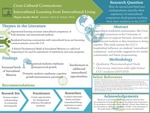
Cross Cultural Connections: A Phenomenological Study of Intercultural Learning from Intercultural Living.
Megan Jacoby Woolf
Higher education administrators and student affairs staff on some residential campuses have attempted to be more inclusive of international students and their U.S. peers by creating co-curricular learning communities addressing intercultural living. Intercultural residential communities, like Cross Cultural Connections (CCC) at the University of Dayton, serve to support the transition to intercultural living for first-year students. Through eight interviews of former CCC residents, this qualitative, phenomenological study explored how the community cultivates intercultural competence. According to the Refined Developmental Trajectory of Intercultural Maturity (Perez, Shim, King, & Baxter Magolda, 2015), former residents of the CCC expressed varying levels of advancements of their intercultural competence. This study assesses the longitudinal success of the CCC's learning outcomes and gives suggestions for similar intercultural residential communities.
-
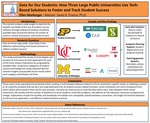
Data for our Students: How Three Large Public Universities Use Tech-Based Solutions to Foster and Track Student Success
Ellen Elizabeth Marburger
Using technological applications and databases for tracking student success in higher education is slowly becoming a necessity rather than a recommendation, especially at large campuses. This content analysis study sought to examine the breadth and depth of the use of these applications amongst three such universities in the midwest by analyzing and coding publicly available data around the themes of evaluation strategies, solutions, and communications. This study first examined the current commentary and research around this topic and defined student success indicators, identified three campuses, and finally compared the systems used, purposes for each, capabilities of each, and what gaps may still exist in the context of using such technology to assist in student success. Key findings suggest that this subset of the field is evolving, and widespread use and integration of these systems may be the next step for campuses and professionals, supplemented by future research.
-
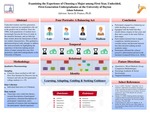
Examining the Experience of Choosing a Major among First-Year, First-Generation, Undecided Undergraduates at the University of Dayton
Adam Thomas Solomon
Over half of all students who withdraw from college do so within their first year, resulting in a first-year attrition rate of over 25% at four-year institutions, and roughly 50% at two-year institutions (Cuseo, 2005). Undecided students and first-generation students represent two populations who are at the greatest risk of attrition. Since the 1980s, both populations of students have increasingly become the focus of study in the retention literature, and yet little has been written about the intersection of these two student characteristics. This qualitative, phenomenological study attempts to address this intersectionality by highlighting the experience of decision-making around choice of major among first-year, first-generation, undecided undergraduates at the University of Dayton. Data collected via one-on-one interviews with participants reveal their extrinsic and intrinsic motivations for choosing a particular course of study, how they conceptualize choosing a major based on post-college aspirations, concerns about being undecided, and key figures who helped guide them through the process of choosing a major.
-
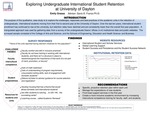
Exploring Undergraduate, International Student Retention at the University of Dayton
Emily Mitolo Grasso
The purpose of this qualitative, case study is to explore the challenges, responses and best practices of academic units in the retention of undergraduate, international students moving from their first to second year at the University of Dayton. The Deans’ offices were surveyed (n = 4) and interviewed (n = 4) electronically, revealing that there are not current retention initiatives for this student population within the academic units. The findings will be shared with the units as well as other support services across campus who may be able to take action to increase persistence of undergraduate, international students past their first year.
This collection contains the capstone projects of students in the master's program in higher education and student affairs (formerly known as college student personnel and higher education administration).
Printing is not supported at the primary Gallery Thumbnail page. Please first navigate to a specific Image before printing.